Question Management
The Question Management wizard helps account and organization administrators with question provisioning across connected accounts, organizations, and clean rooms.
You can also edit or clone, or provision a question if you have access to Question Builder.
Tip
Get Notified with Question Run Updates
Make sure you've enabled email or in-app notifications to get notified when a question run has failed or completed. To enable notifications, click the Profile icon on the top right side of your screen, select "Manage Notifications", and check the boxes for "Question run status updates".
Clean Room Questions
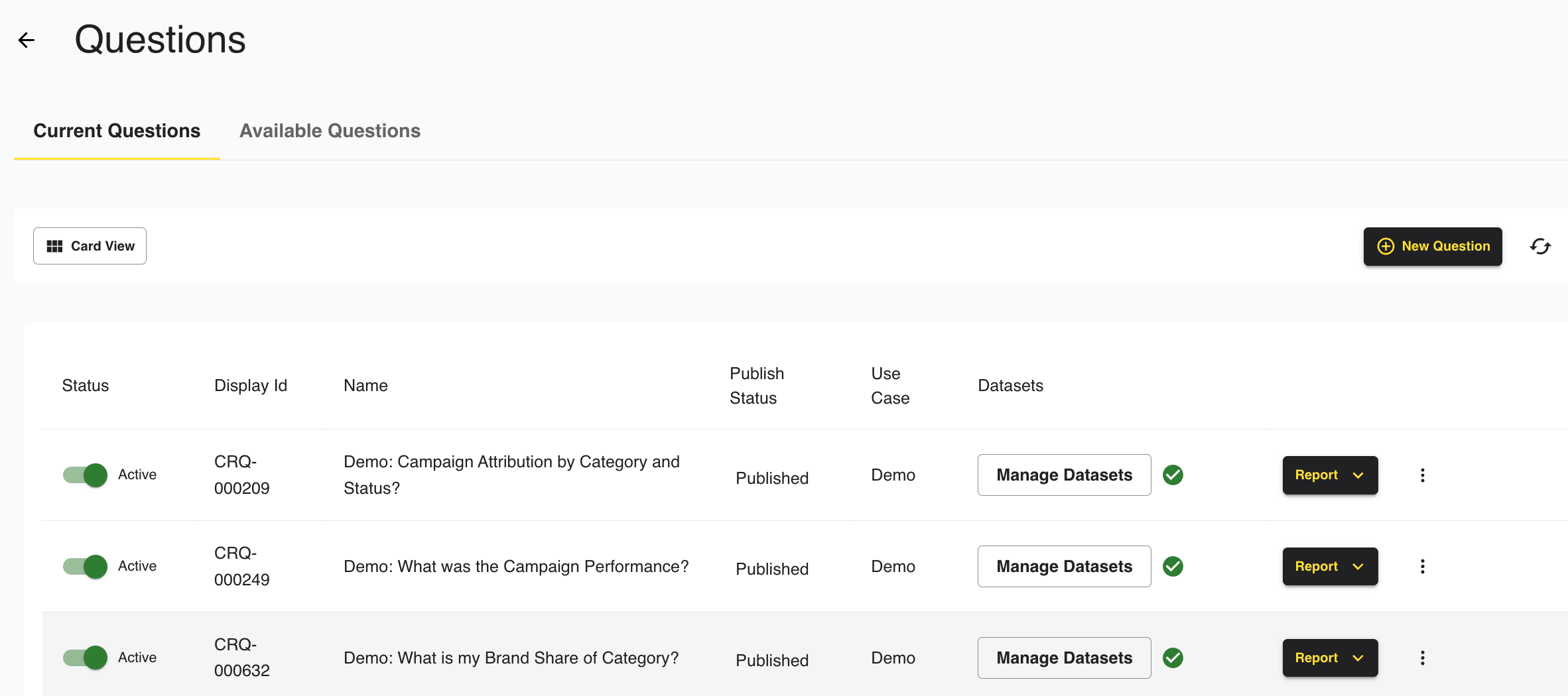
Once you've entered a clean room, you can see all available questions for that specific clean room.
Depending on your permissions, the following question-level actions can be taken from the Questions page:
New Question: Click to open Question Builder.
Report: From the Report list, click , , or to see all question runs and outputs. If you have Clean Room Intelligence enabled, it can also be accessed from this list.
Extended Menu: Next to the Report list, select the additional menu icon to clone the question (if permissions are enabled) or delete a question from the clean room.
Manage Datasets: Add datasets to a question and assign ownership if you are a clean room owner or to assign your dataset types if you are a clean room partner. If datasets have not yet been configured, an i icon is. A green checkmark icon is displayed if datasets are already configured.
For information about questions, see "Question Builder".
Provision a Question
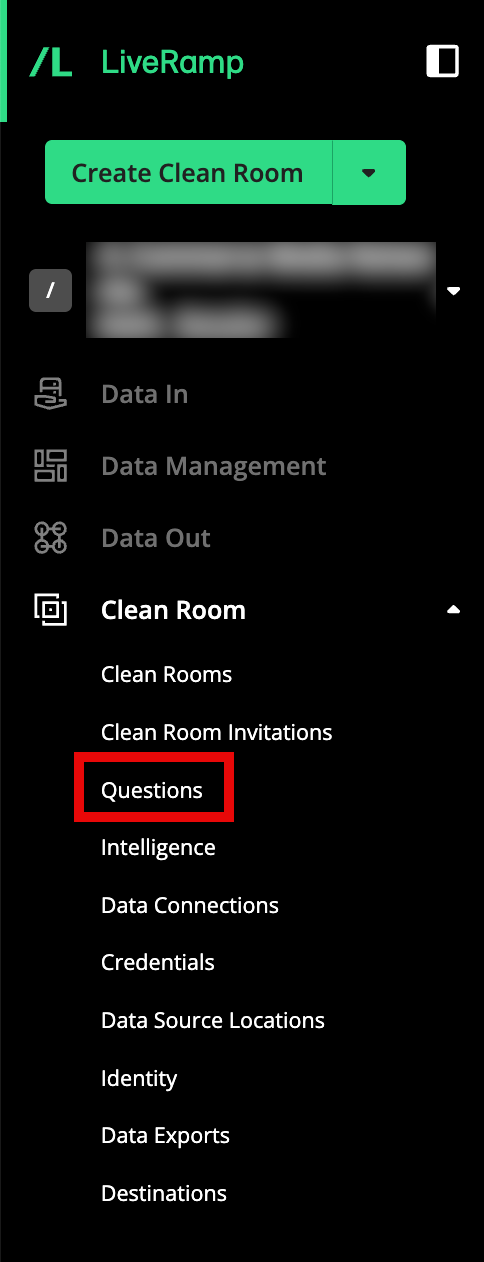
From the navigation menu, select Clean Room → Questions to open the Questions page.
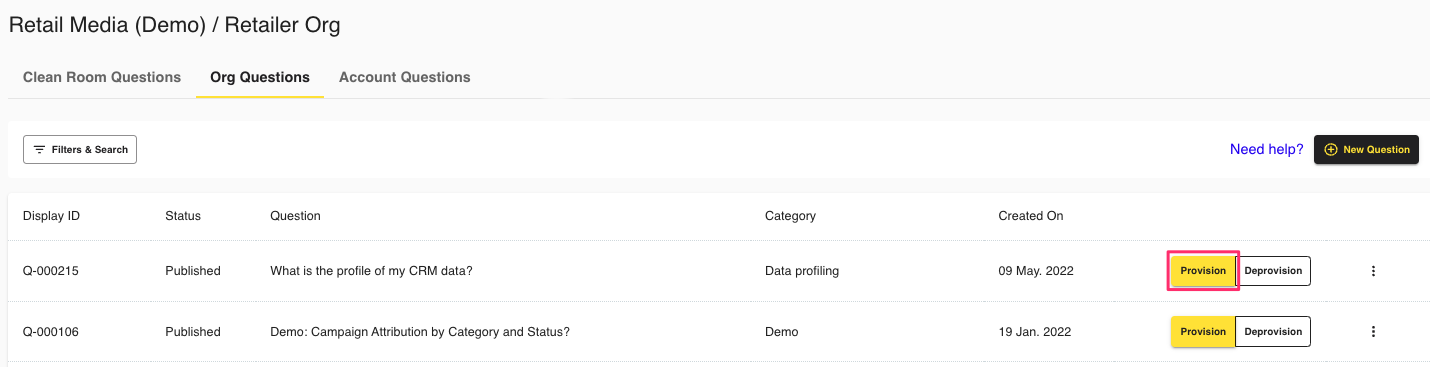
The following tabs display options to provision questions at different levels:
Clean Room Questions: All questions in the organization's clean rooms where the user has access.
Org Questions: All questions available to provision or deprovision in the current organization. This tab will only populate for users with Question Management admin access in the organization.
Account Questions: All questions available to provision or deprovision across organizations in the current account where the user has Question Management admin access.
In any tab, click next to the question you want to enable.
Select the accounts, organizations, and clean rooms where you want to provision the question. Those selections will populate at the top of the wizard where they can also be removed.
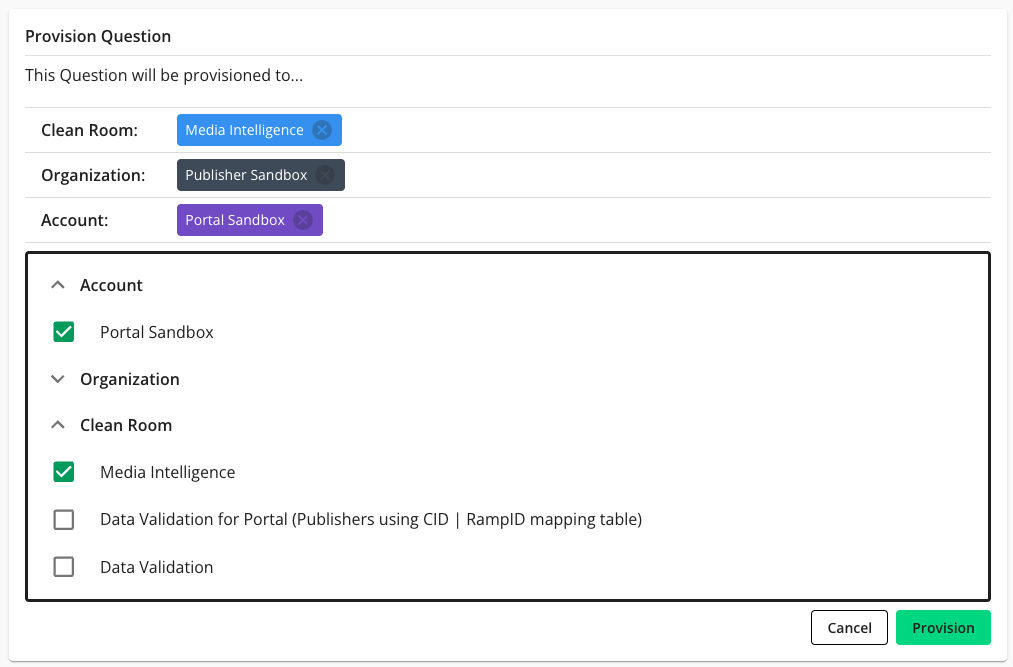
Only accounts, organizations, and clean rooms that the user has access to will populate in the dropdown lists.
Once you've made all your selections, click . The question will now be displayed in the specified accounts, organizations, and clean rooms.
Note
This view is only for question provisioning and does not show whether a question is already provisioned elsewhere in another account, organization, or clean room. To see where a question has already been provisioned, select Settings from the More Options menu (
 ) next to the question.
Create a Question Run
Selecting View Reports next to a question will populate the list of question runs for that question.
The following question run-level actions can be taken from the Question Runs page:
Add New Report: Create a new question run.
View Report: See the visualization for a specific run.
Delete: Delete a question run.
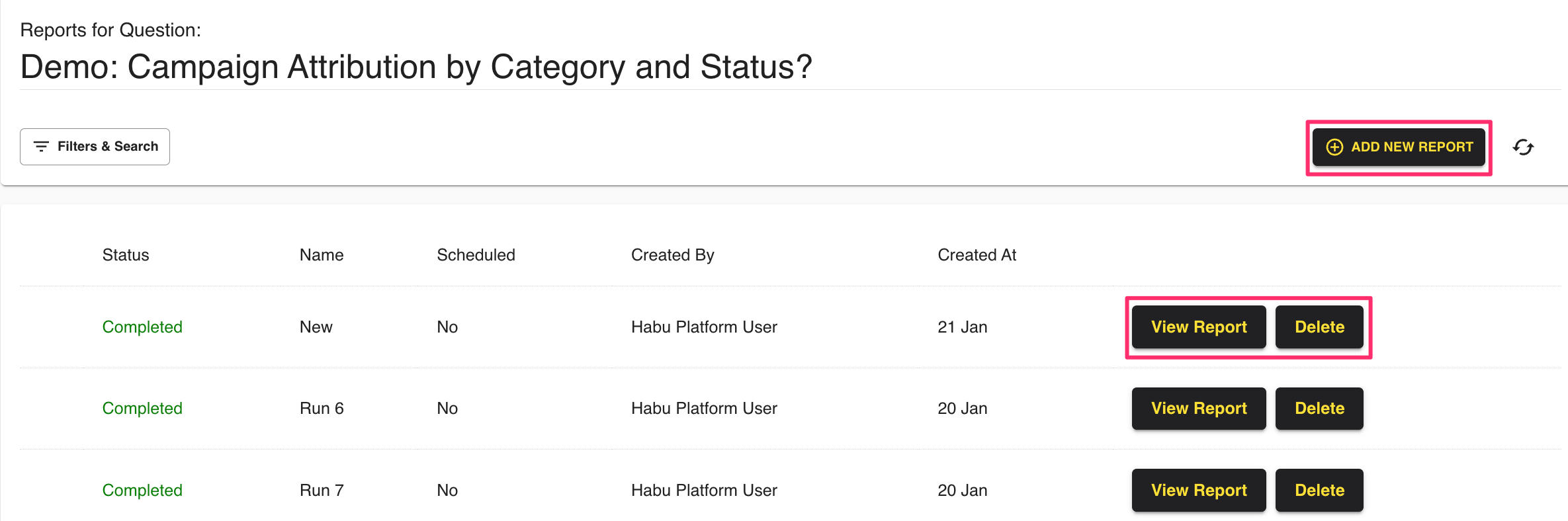
Consider the following when creating a question run:
runtime parameters may differ per question and contain different attributes beyond dates.
Run dates should typically span one month or more for optimal results and alignment with planning and optimization use cases.
If you have an industry clean room (ADH, AMC, or FAA), question runs should not be run multiple times for the same date range to avoid differential privacy according to each industry clean room's requirements.
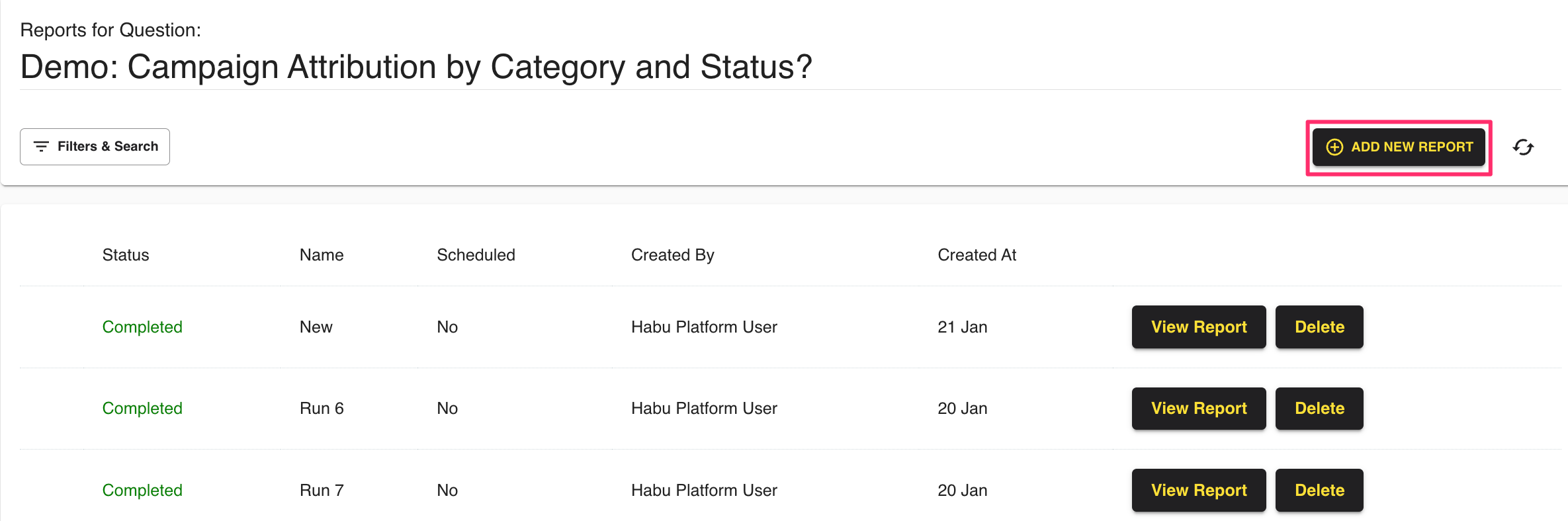
From the Question Runs screen, click .
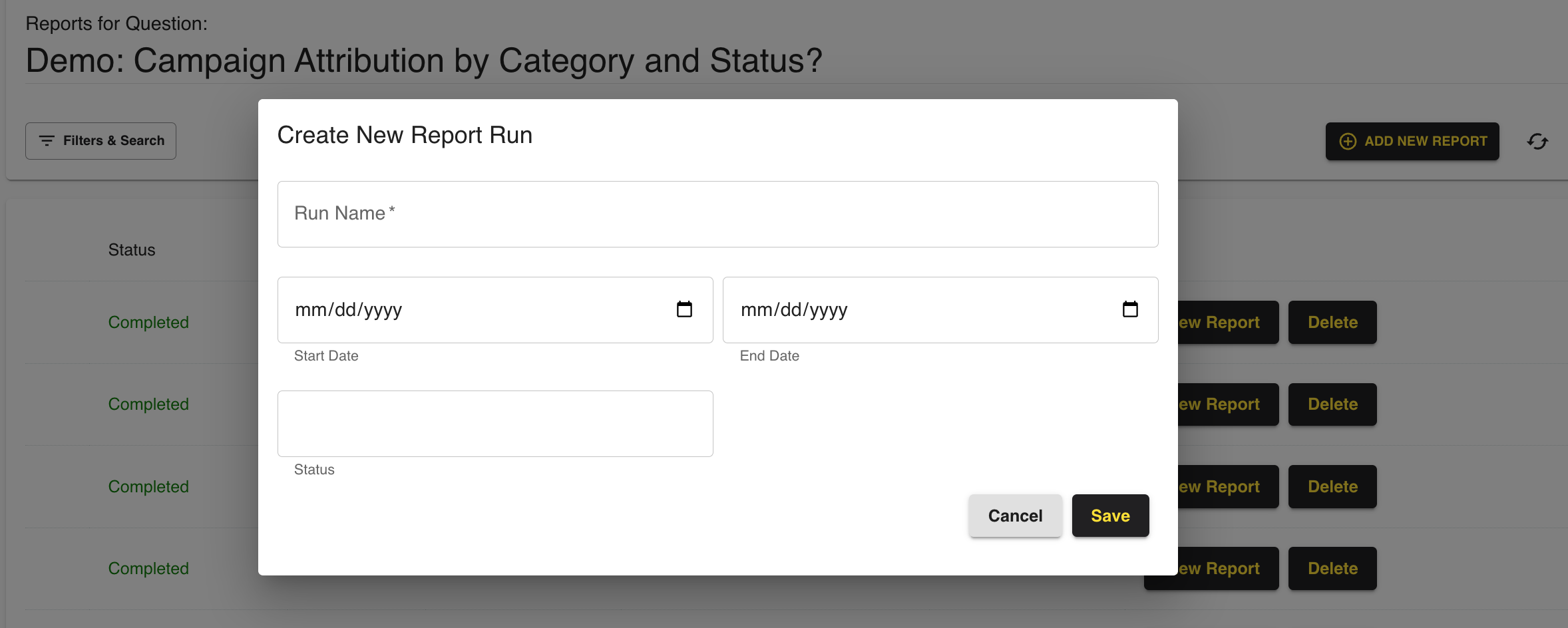
Enter a name for the question run and the runtime parameters (dates) you want.
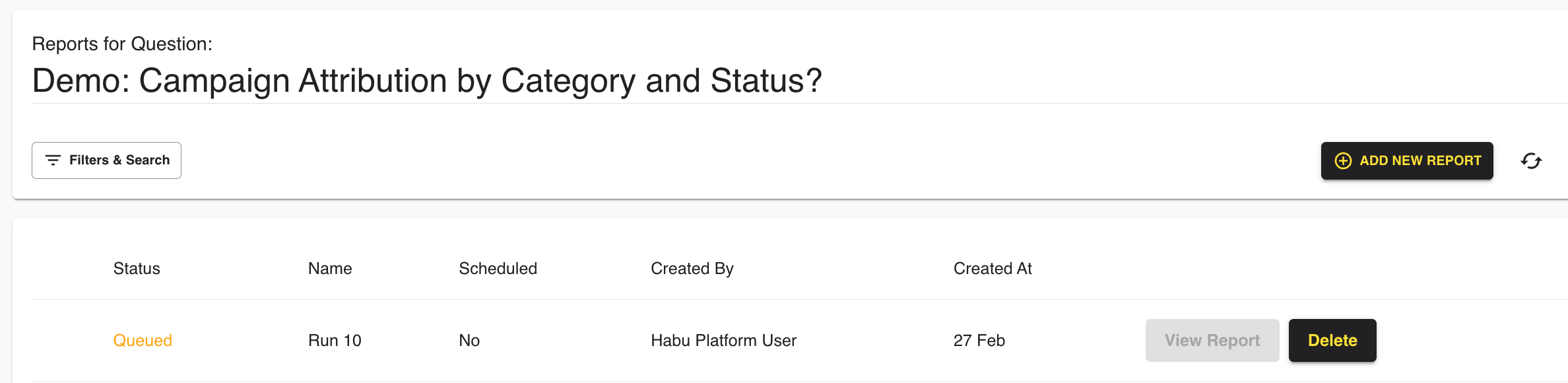
Click . The run will display in Queued status, followed by Running, and then Completed.
Once the run completes, click to see the associated insights.
Visualizations include a chart view and a table view.
In the "Page Settings" section, you can do the following:
Question: Switch between questions within the clean room you are in.
Question Run: Switch between runs for the question being viewed.
Question-Specific Filters: Filter the question results by different dimensions, which differ by question and use case.
To download the results as a CSV file, click .
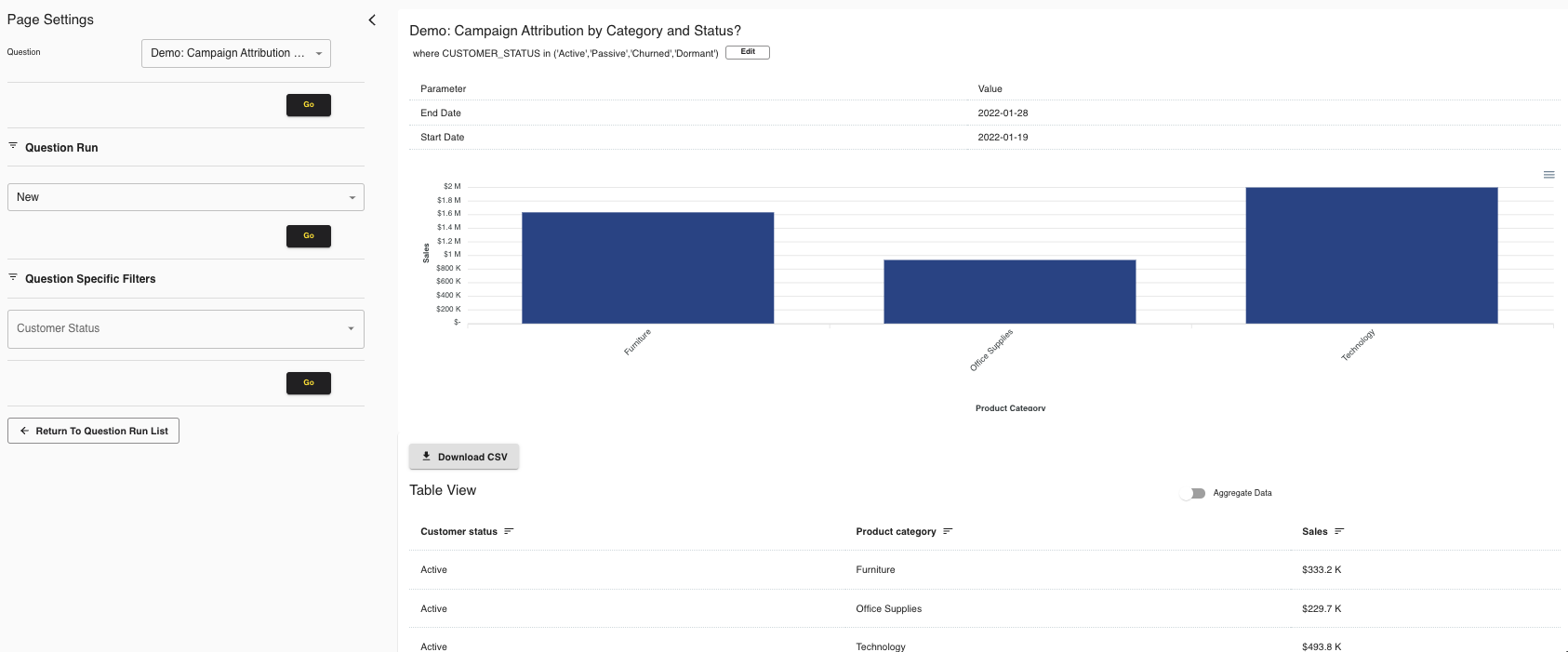
If your organization has access to LiveRamp Clean Room Intelligence, you can access its visualizations. For more information, see "Visualizations and Analysis".
Schedule Runs
You can use the Schedule Runs option to automate the creation of question runs instead of manually creating each run. If scheduled runs are not available for your organization, contact your LiveRamp representative.
Click next to a question and then select Schedule Runs.
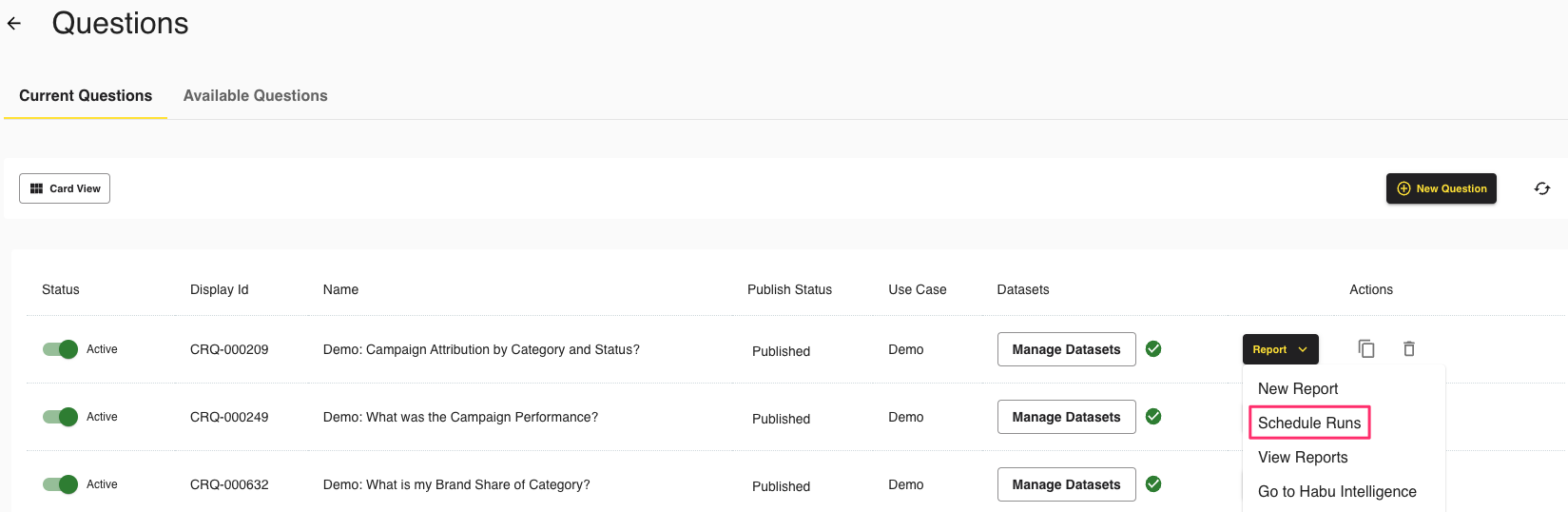
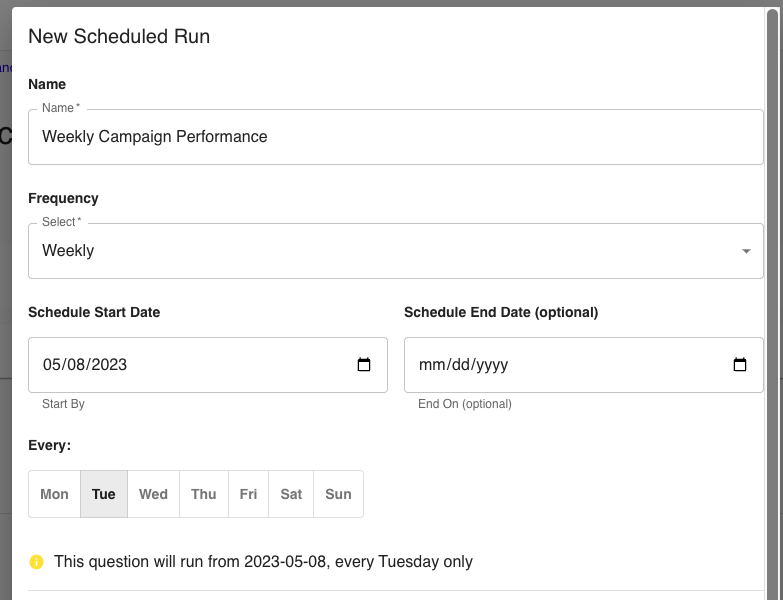
Click New Scheduled Run.
Enter a name for the run.
Select the frequency the reports should generate (daily, weekly, monthly).
When selecting Weekly, you can then select which days of the week the report should run under Every.
When selecting Monthly, you can then select the specific days the report should run each month under Every.
Select a start date. This is when the scheduled runs will begin generating. If needed, select an end date. Otherwise, scheduled runs will continue generating indefinitely.
For example, if you want to run weekly automated reports throughout the last quarter of the year, select October 1 as the Schedule Start Date and December 31 as the Schedule End Date. This means reports will populate weekly on the specified days beginning on October 1 and will no longer automatically run after December 31.
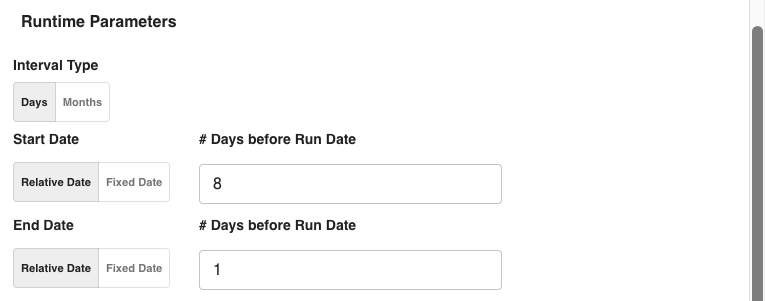
In the "Parameters" section, select the interval type:
Days: Select the relative date (number of days prior to the run date) or a fixed date for the start and end date that the report output should reflect.
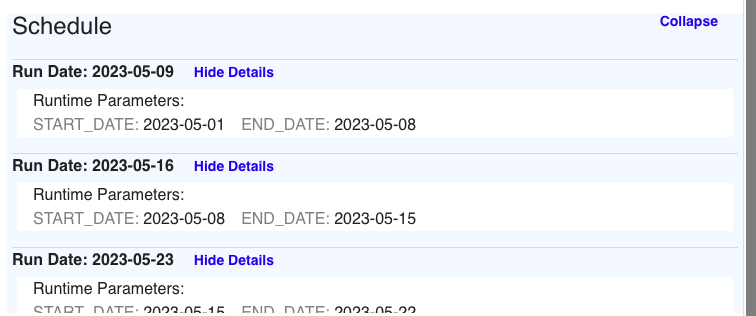
For example, when using relative date, if you want to receive weekly automated reports on Sundays that populate data for the previous week (such as Monday through Saturday), the number of days before the run date should be 8 days for the start date and 1 day for the end date.
Months: Select the number of previous months each report output should reflect. In Question Builder, the query must have the @START_DATE and @END_DATE data parameters enabled in order to schedule runs by Month.
If your question has additional runtime parameters, the name of each parameter will populate with an open field. Enter the runtime parameters applicable to your scheduled run.
At the bottom of the New Scheduled Run page, the run schedule will populate based on how you've configured the schedule. This shows you the exact dates when runs will occur. Clicking See Details will show the runtime parameters that will be applied on a given day's run, including the run dates that will be reflected in each run output.
Click .
Using Date Parameters
If you do not enable date parameters in the question you are scheduling, the run automatically occurs on the schedule you selected and includes data available from the database in the run results.
If you do have date parameters enabled in your query, there are two ways you can further refine the schedule for your question runs:
Relative Date: Select the number of days prior to the scheduled run that run results will generate. For example, if you want each run to include the previous 7 days of data, enter ‘8’ in the first box and ‘1’ in the second box.
Fixed Date: Select the date that the results should populate data from. For example, if you enter January 1, 2025, each scheduled run will populate data from January 1, 2025, until the scheduled run date.
Edit a Question
When you edit a question, any datasets that have been assigned to that question get automatically unassigned so that the dataset owners have a chance to review the question before their dataset is used.
Note
If your organization has been enabled for retaining dataset assignment, any datasets you own will stay assigned to questions you edit. In addition, if any partner datasets have been enabled for "Partners Can Assign", those datasets will stay assigned as well.
This feature is in limited release so check with your LiveRamp representative about having it enabled. We anticipate releasing this feature to all customers in the near future.
From the navigation menu, select Clean Room → Questions to open the Questions page.
From a question's More Options menu (
), select Edit.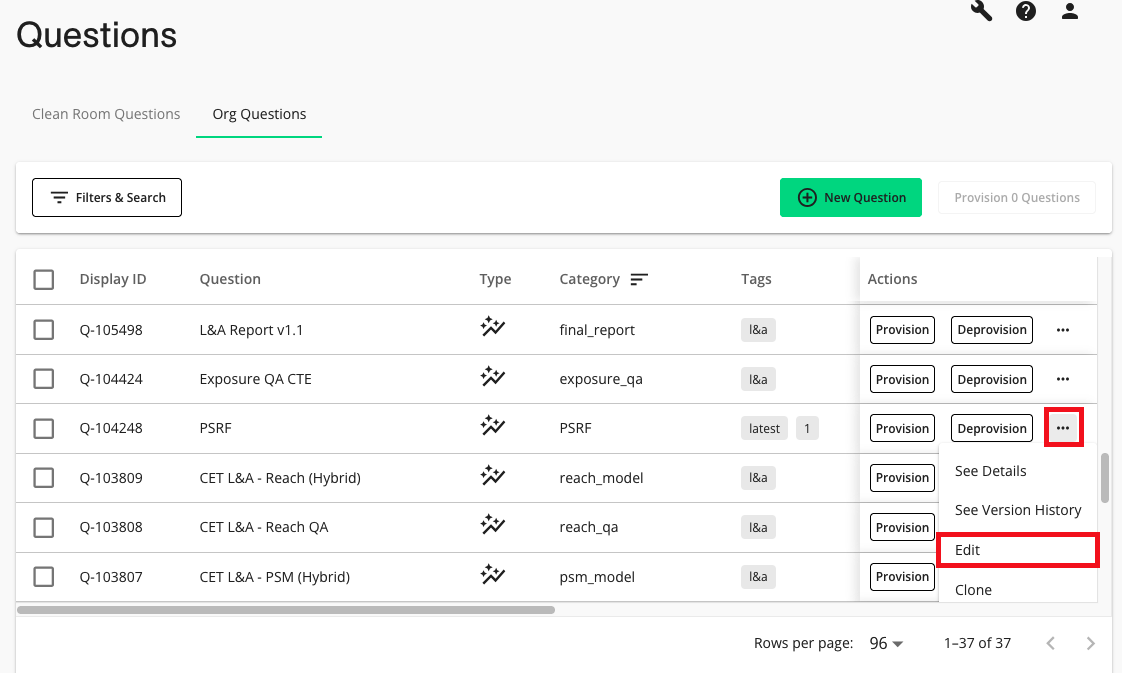
In Question Builder, edit the SQL query powering the question, and then click .
Make any needed changes to the report configuration, and then click .
Deprovision a Question
You can deprovision questions from clean rooms, organizations, and accounts.
Question management has no impact on current questions within a clean room, such as question availability or question runs.
In any question tab, click .
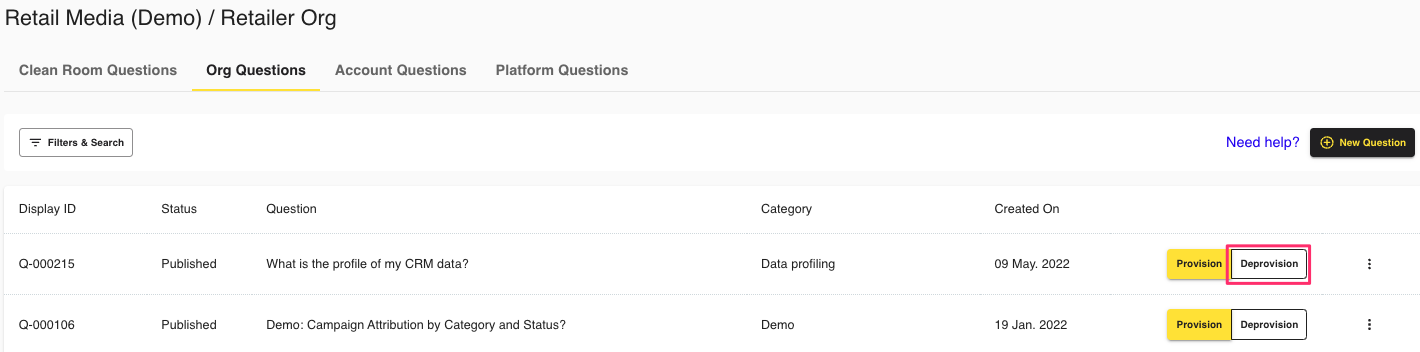
The Question Settings dialog displays Clean Room, Organization, and Account tabs to which you have access.
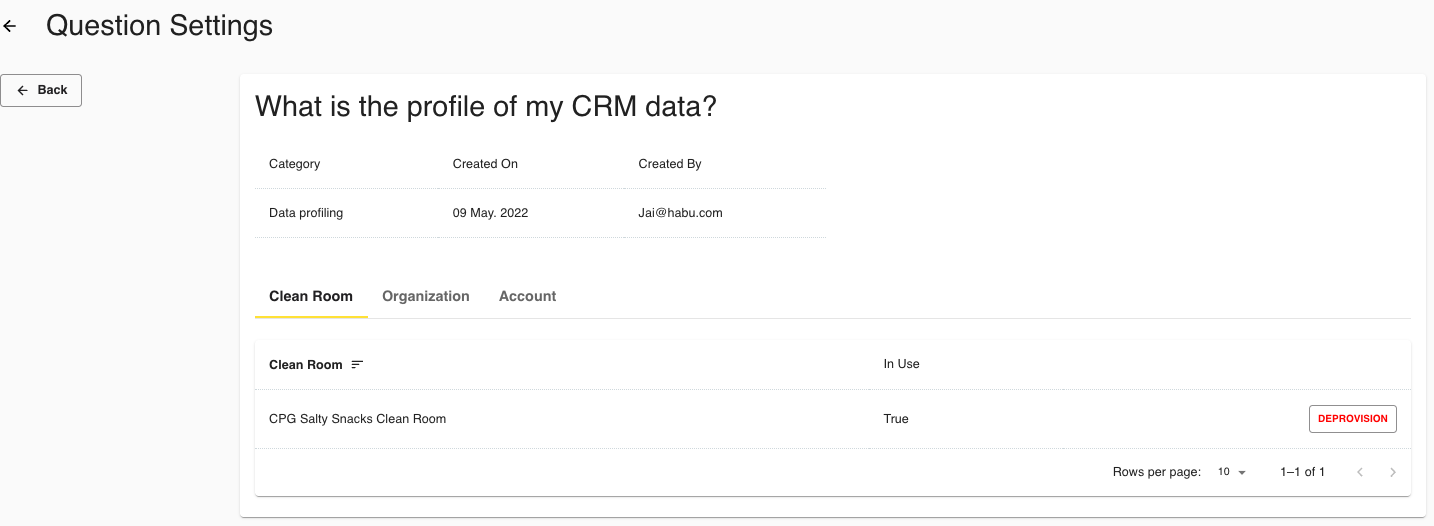
Click for the clean rooms, organizations, and accounts for which you want to deprovision the question.