Getting Started with Conversions API Feed Distribution for Retail Media Networks
If you’re a retail media network, you may implement Conversions API (CAPI) programs to measure how ad campaigns result in real customer actions for the different brands you’re working with. LiveRamp’s Conversions API integration allows you to connect conversion data to create per-brand feeds and share them with brand partners or distribute them to destination platforms directly in Connect.
By connecting your conversion data, you can filter your conversion feed based on SKUs and other defined attributes, or split them into brand-specific views, ensuring only data that’s needed for each brand advertiser is sent for measurement to platform partners such as Google or The Trade Desk.
Brand advertisers can then ensure their campaigns optimize only for SKUs relevant to their objectives.
Caution
This program is currently in limited availability. If you don't have access, you can still leverage other LiveRamp Conversions API integrations. For more information, see "Conversions API Programs".
Overall Steps
There are two workflow options, which affect who performs the distribution step in Connect:
Retailer-managed distribution: The retailer handles the distribution of conversion data in Connect and manages the resulting attribution reports on the brand's behalf.
Brand-managed distribution: The brand partner distributes the conversion data in Connect and manages their own attribution report at the destination platform.
For retailer-managed distribution, the overall steps are:
Upload your conversion file to LiveRamp.
Create a conversion event feed table in Connect.
Distribute the event feed to configured destination accounts.
For brand-managed distribution, the overall steps are:
In addition to your conversion file, upload a product mapping file to LiveRamp.
Create a product mapping table in Connect.
Create a filtered conversion event feed view.
Share the event feed view with brand partners.
Note
To enable event filtering under either workflow, complete the additional steps listed under brand-managed distribution. You can then distribute the resulting filtered event view yourself or share it with brand partners for them to distribute.
Prepare Source Files for Ingestion
Follow the formatting instructions below for each file type before uploading to LiveRamp.
Conversion Feed File
Your conversion feed data should be formatted based on the guidelines of the universal file for multiple conversions API programs. In most cases, you will only need to use one universal file for all of your conversion programs. See "Situations That Require Additional Files" for more info.
Download the file template by clicking here.
If desired, you can remove any non-required columns that aren't utilized by one of your conversion programs, but you can also leave those columns in the file and not populate them with values.
Transfer your data into the template.
After transferring your data into the file template, delete the second row with the formatting instructions.
Save the file as one of our allowed file types (.csv, .tsv, .psv, or .txt).
See “Using a Universal File for Multiple Conversions API Programs” for more information.
Mapping File (Optional)
For brand-managed distributions or to enable filtering of your conversion events, you must prepare a file that maps product-level data to ad campaign attributes. You can use the table attribute columns to define the rules that determine which products (SKUs), brands, or other attributes are included in each conversion feed.
Your source file must contain the following columns:
Product category
Product brand
Product SKU/ID
If available, we recommend including the additional columns below to easily enable per-campaign filtering and reporting in your conversion feeds:
Campaign ID
Campaign start date
Campaign end date
To download a file template with example values, click here.
Upload the Files to LiveRamp
Upload conversion data files using LiveRamp’s SFTP server or your SFTP server.
You can also have us pull files from an AWS S3 bucket or GCS bucket. See “Getting Your Data Into LiveRamp” for more information.
Caution
Files for this program cannot be uploaded via Connect. We recommend either uploading via our SFTP server or having us pull files from an S3 bucket.
To upload files using LiveRamp's SFTP: Use the credentials provided by your technical contact once the agreement has been signed and follow the instructions in “Upload a File via LiveRamp's SFTP”.
To upload files using your SFTP: Follow the instructions in “Upload a File via Your SFTP”.
To learn more about the Online Conversions API connectors, see "Online Conversions API Connectors".
Note
For future uploads, you do not have to email LiveRamp to confirm that you have uploaded data assuming headers have not changed or additional columns have not been added.
Create an Offline CAPI Event Feed Table
During the table creation process, you will map the fields you want to include and configure how input identifiers should be resolved.
Note
Event feed tables for online events are automatically generated once LiveRamp has enabled the Online CAPI connectors for you. Talk to a LiveRamp representative to help with the setup.
From the navigation pane, select Data Management → Tables and Views and click .
On the Select Intended Use step, select Use to Create a CAPI Event Feed, and click .
From the Configure Table step, fill out the following required fields:
Template: Select the appropriate template for your use case, which will determine the remaining steps in the process:
PII Matching: Select this template to resolve online or offline identifiers to a RampID.
Online Matching: Select this template to match online custom identifiers to RampID.
Transcoding: Select this template to transcode online identifiers to a different partner encoding, in addition to resolving identifiers to RampID.
Non-Matching (Passthrough): Select this template to pass identifiers without matching, transcoding, or any leveraging of LiveRamp's Identity Graph.
If Non-Matching is selected, select whether the input contains raw or hashed identifiers via the Input PII Type dropdown.
Configuration name: The name for the configuration.
Table name: The name of the asset that will display on the Tables and Views page.
GCS Bucket Data Source: The Google Cloud Storage (GCS) bucket where the data source is located.
Source File Path: The file path within the above-specified GCS bucket (for example, “/input/liveramp-test-file.csv”).
The format of the data, which can be CSV or Parquet.
Delimiter Configuration: If you are using a CSV file, select Auto Detect or Manual to manually specify delimiters.
Number of Rows to Exclude: Enter the number of rows (such as header rows) to exclude. Enter "0" if your file doesn't contain a header.
Files to Process: Select which files you want to scan and process from the source location.
All Files: Current and future files. Files which have already been processed will be reprocessed
New Files: Only the newest files added since the time of the latest process. Current files, even if they have not been processed, will be skipped.
None: Only process remaining unprocessed files. New files and files which have already been processed will be skipped.
Click .
If you selected the "Matching" or "Transcoding" template in the previous step, the Configure Identity Resolution step displays. During this step, you must define the identifiers in your input file that you’d like to match or transcode on.
Note
If you are working with Identity Engine, you must select one identifier type to create Enterprise IDs from.
If you selected the “PII Matching” template:
Identifier Type 1: Select the type of identifier available in your input file.
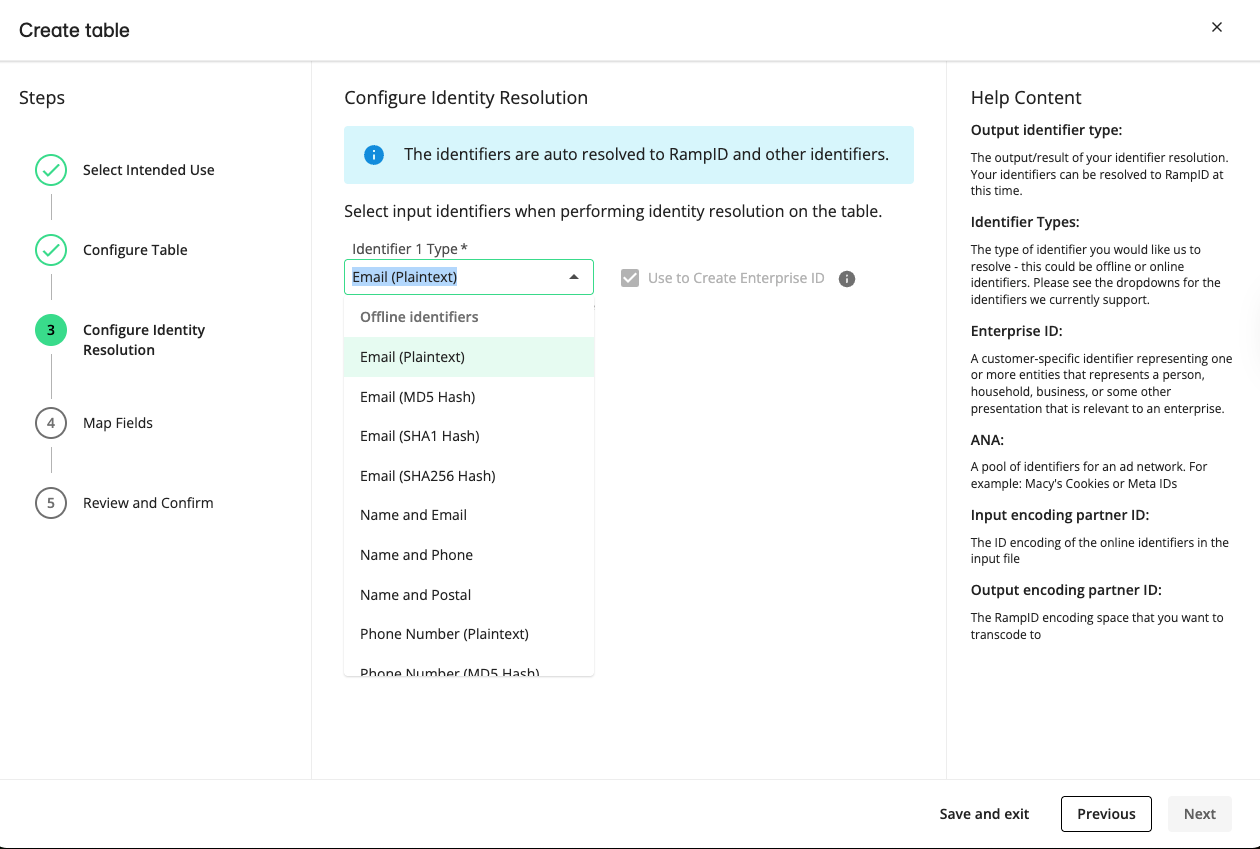
Identifier 1 Field: Select the column in your file that contains the selected identifier type.
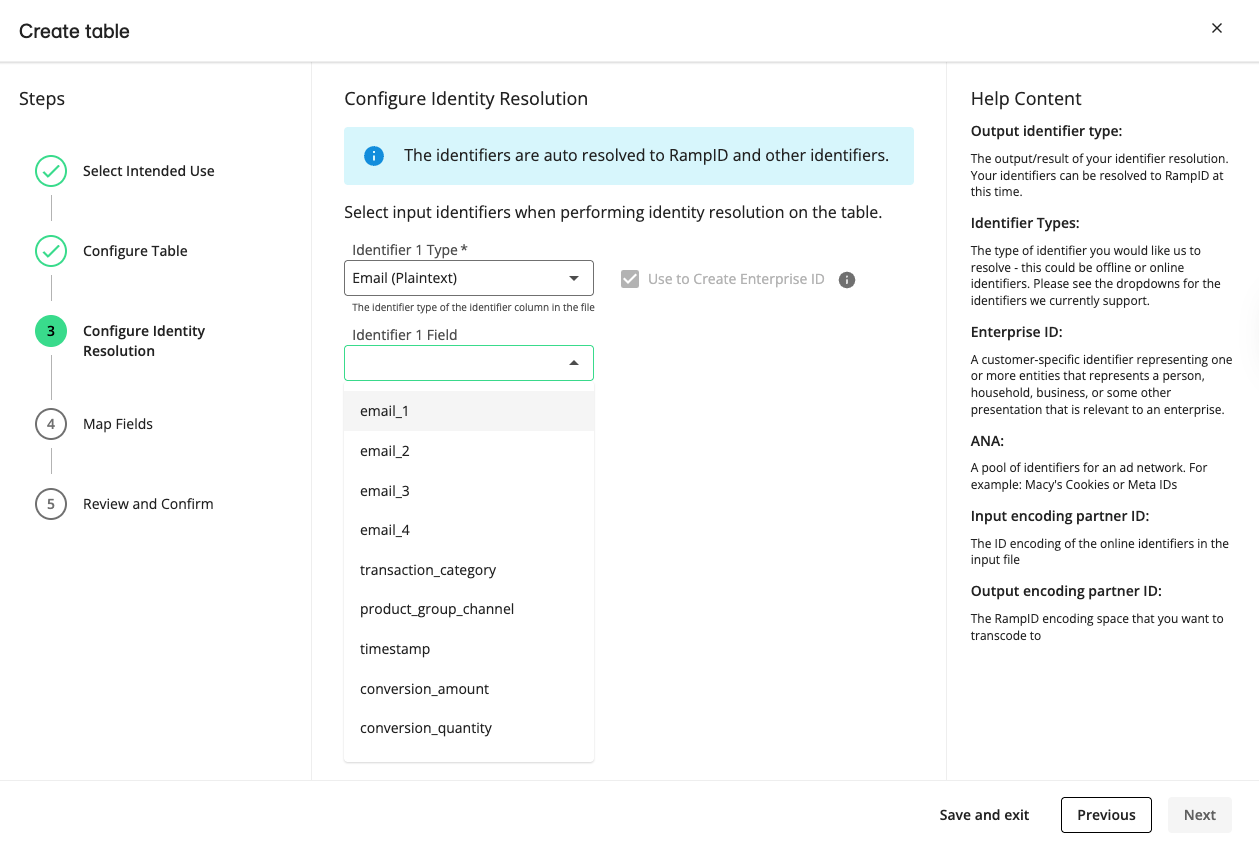
To resolve multiple identifier types, click and repeat the steps above.
If you selected the "Online Matching" template:
Identifier 1 Field: Select the column in your file that contains the Custom ID (CID).
Ad Network Account ID (ANA): Select the identity space the input identifiers belong to from the list of identity spaces associated with your account.
If you selected the “Transcoding” template:
Identifier Type 1: Select the type of online identifier in your input file you want to transcode.
Identifier 1 Field: Select the column in your file that contains the selected identifier type.
Ad Network Account ID (ANA): Select the identity space the input identifiers belong to from the list of identity spaces associated with your account.
Input Encoding Partner ID: The 4-digit encoding ID of your organization that appears after the first two letters of your RampIDs.
Output Encoding Partner ID: The 4-digit encoding ID of the LiveRamp partner that you want to transcode to.
Tip
Encoding id is a 4-digit number unique to the partner using them that appears as part of each RampID’s value after the two-character prefix.
For example, in the RampID "XY1005wXyWPB1SgpMUKIpzA0I3UaLEz-2lg0wFAr1PWK7FMhs", the partner encoding is “1005”.
To resolve multiple identifier types, click and repeat the steps above.
Click .
In the Map Fields step, perform the following actions:
Note
Any identifier fields you've configured to be used for matching in the Configure Identity Resolution step are excluded from this step.
If a field has an asterisk at the beginning of its row, you must configure certain advanced settings by clicking on the row and then completing the applicable steps below. Once the required configurations have been completed, the asterisk will no longer display.
Select the fields: To include a field in the table, slide the toggle under “Include” for that field. If needed, you can use the search bar to find the desired field.
Adjust the field type: For each field, confirm or adjust the field type that was detected from the file.
Rename the field: If necessary, click the field’s row and then enter a new field name in the FIeld Name in Table field.
Apply privacy transformations: For each field included in the table, click , , or to apply your desired privacy transformation. The following hashing options are available:
No Salt: Applies standard MD5 directly, without a salt.
Default Salt: Applies MD5 with LiveRamp’s hardcoded universal salt.
Custom Salt: Applies MD5 with a salt that you provide.
Add a field description: To add a field description, click the field’s row and in the side panel that opens, enter a description in the Description field.
Click .
Review your table configuration, and click .
The table you’ve created displays on the Tables and Views page at the top of the list. You can view its details by double-clicking on the row to open the full detail page. To learn more, see "View Details for Tables and Views".
Note
When you distribute a CAPI event feed table, LiveRamp automatically creates an unfiltered CAPI event feed view based on that table.
Distribute the Conversion Event Feed to Destination Platforms (Retailer-Managed Distribution)
Conversion events are delivered to destination platforms by way of distributing them to destination accounts in Connect. For information on all available CAPI destination accounts, see "Conversions API Destinations and Distribution Information".
During the distribution process, LiveRamp will perform a validation check to ensure all fields required by the selected destination platforms are included. To avoid a failed validation check, make sure to:
Check your event feed source file against our universal file format to see if all required columns are present. See “Using a Universal File for Multiple Conversions API Programs” for more information.
If you are sending item-level/product array data, check for additional field requirements in the universal file for sending those data.
Make sure to select the correct destination account that matches your file format (i.e., product array or non-product array).
Activate the Desired Destination Accounts
When activating a Conversions API destination account, you are required to provide the relevant ad account ID you want the data to be delivered to at the destination platform. Some of our destinations require that an authorization using OAuth be performed by a user with the appropriate permission level before any distributions can be made to that destination.
For instructions on activating CAPI destination accounts, see "Conversions API Destinations and Distribution Information".
Distribute the Event Feed View
Once the desired destination accounts have been activated, you can now distribute your event feed.
On the Tables and Views page, click the More Options menu (
 ) of an event feed table or view and select "Distribute Event Feeds".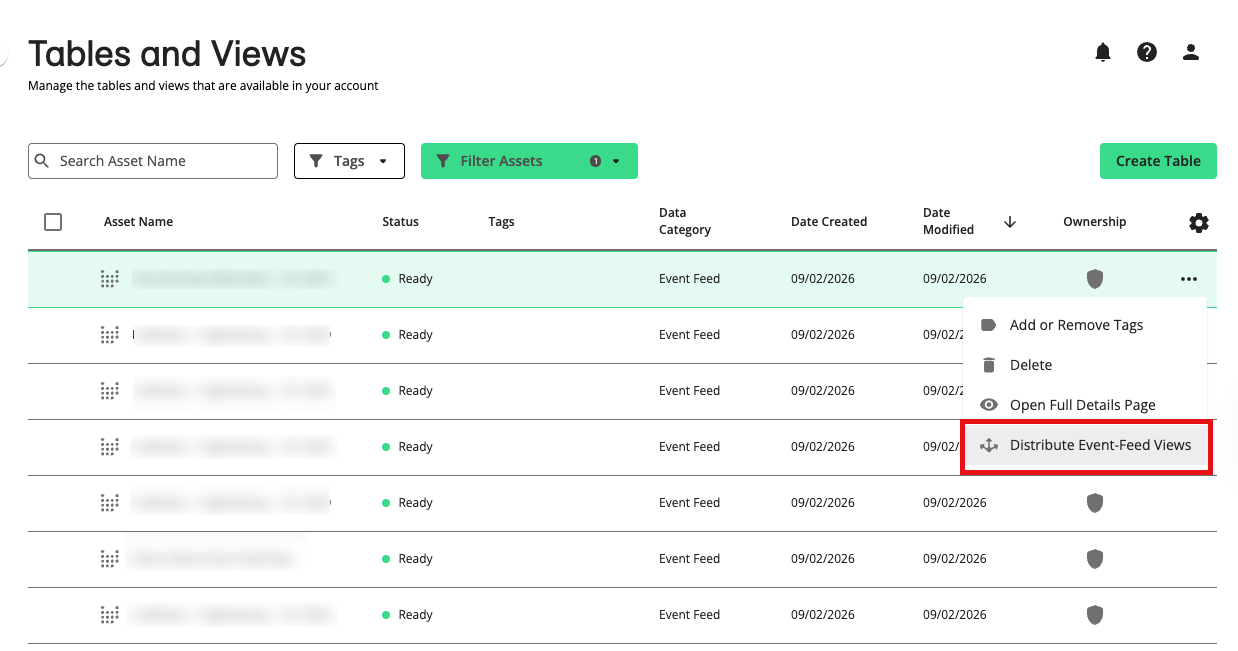
(Optional) Click and select any additional views you want to distribute.
Click .
From the Select Destinations step, check one or more boxes for the CAPI destination accounts you want to distribute the views to.
Click . LiveRamp checks whether your file is missing any fields required by the selected destination platform.

If a row's validation status displays “Incompatible”, hover over the status to see the missing requirement.

Warning
If your file is missing a field, you must reupload the file, making sure the required field is included.
When all selected platforms show a validation status of “Compatible”, click Distribute Event-Feeds.
Once you've distributed your data, it typically takes 1-3 days for the data to arrive at the destination platform. Once delivered, your platform partner can then create an attribution report that can be viewed on their ad manager platforms or send the report to you directly.
Create a Product Mapping Table
Create a product mapping table so you can use its attributes to apply filtering on your conversion event feed table. Once your product mapping files have been uploaded, follow the instructions below to configure your product mapping file in Connect and manage it as a data asset.
From the navigation pane, select Data Management → Tables and Views.
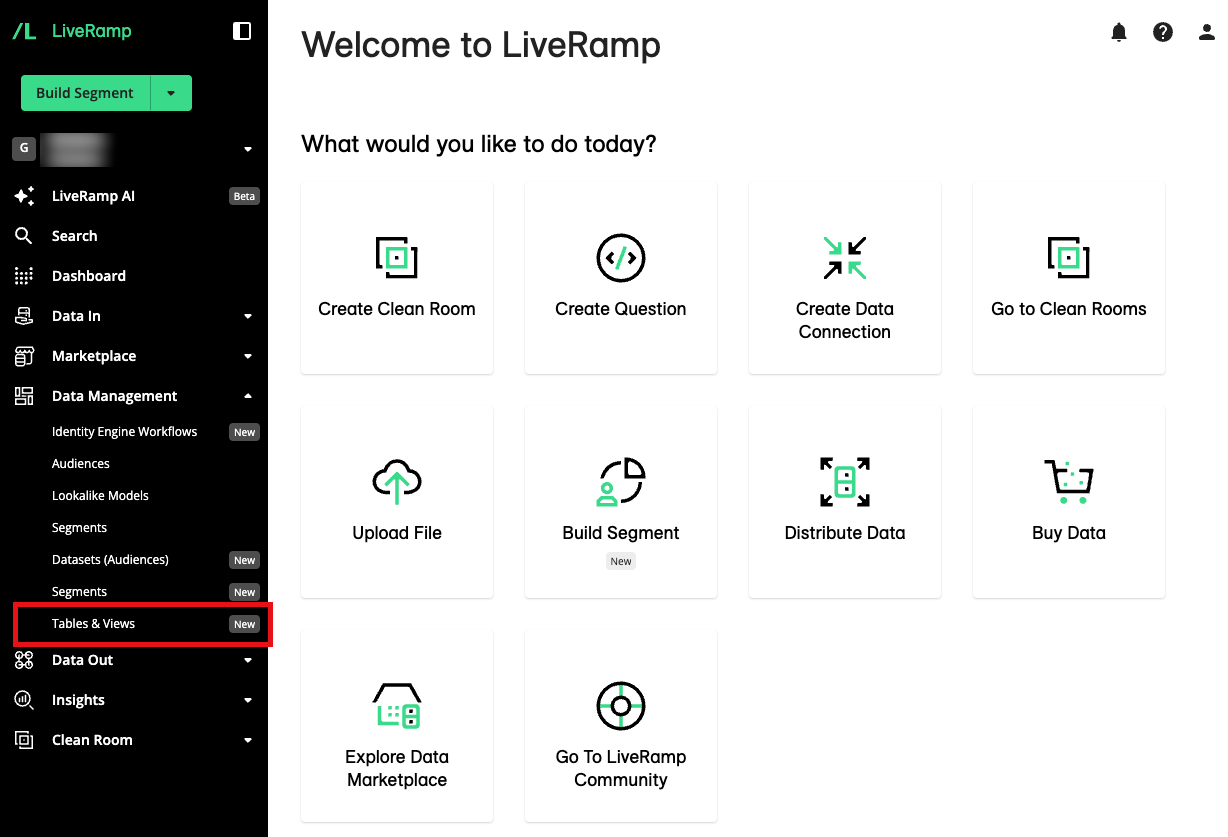
Click .
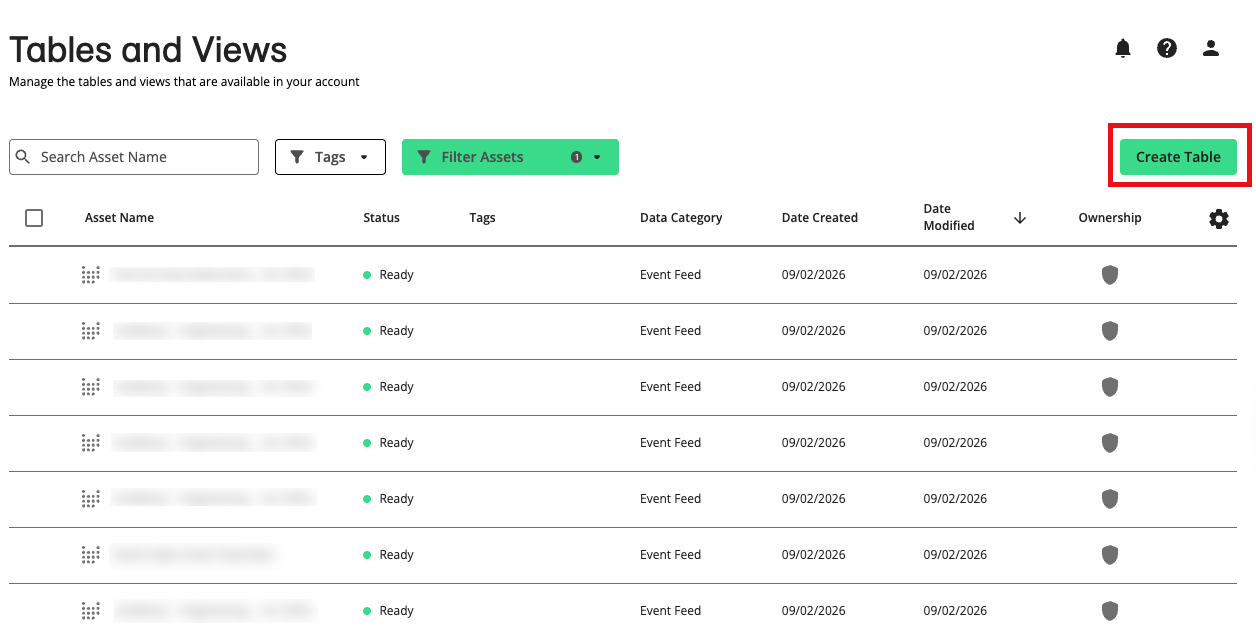
From the Select Intended Use step, select Use to Create a CAPI Product Mapping, and then click .
From the Configure Table step, fill out the following required fields:
Configuration name: The name for the specific configuration. This name will display in the Details pane of the asset.
Table name: The name of the asset that will display on the Tables & Views page.
Note
The update method is set to Batch Refresh by default. This method refreshes and upserts data when key columns are found in new files. You will define the key columns on the next step.
GCS Bucket Data Source: The Google Cloud Storage (GCS) bucket where the data source is located.
Source File Path: The file path within the above-specified GCS bucket (for example, “/input/liveramp-test-file.csv”).
The format of the data, which can be CSV or Parquet.
Files to Process: Select which files you want to scan and process from the source location. See the options below:
All Files: Current and future files. Files that have already been processed will be reprocessed.
New Files: Only the newest files. Current files, even if they have not been processed, will be skipped.
None: Only process remaining unprocessed files. New files and files which have already been processed will be skipped.
Click .
From the Map Fields step, map the columns found in your source file by using the dropdown options under Map Column for each field. You’re required to map the Product Category, Product Brand, and Product SKU ID to the relevant columns in your file before you continue.
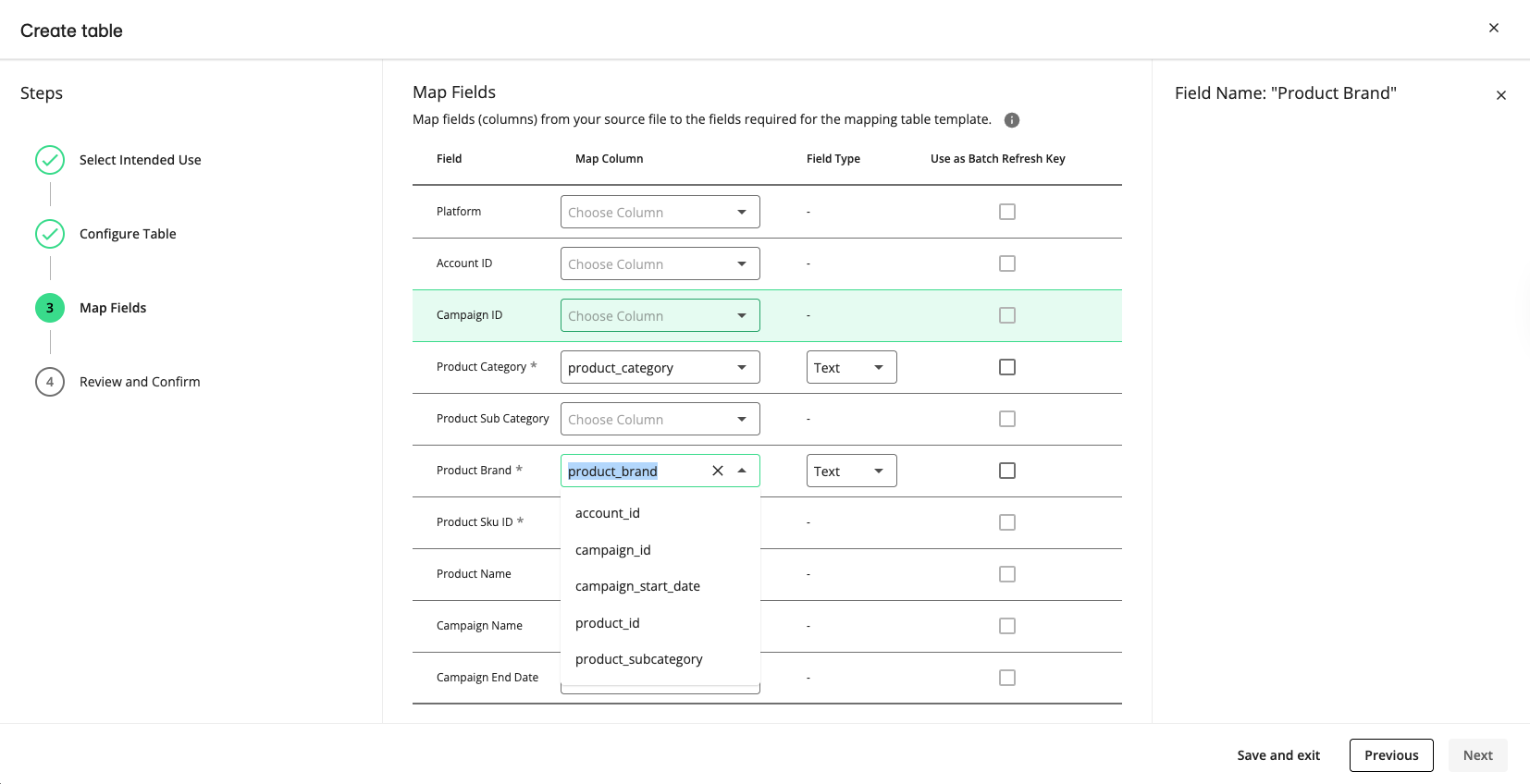
Once the fields have been mapped, select which ones to use as a batch refresh key by checking the "Use as Batch Refresh Key" box. LiveRamp will search for columns marked as keys in new ingested files to determine whether the data should be refreshed.
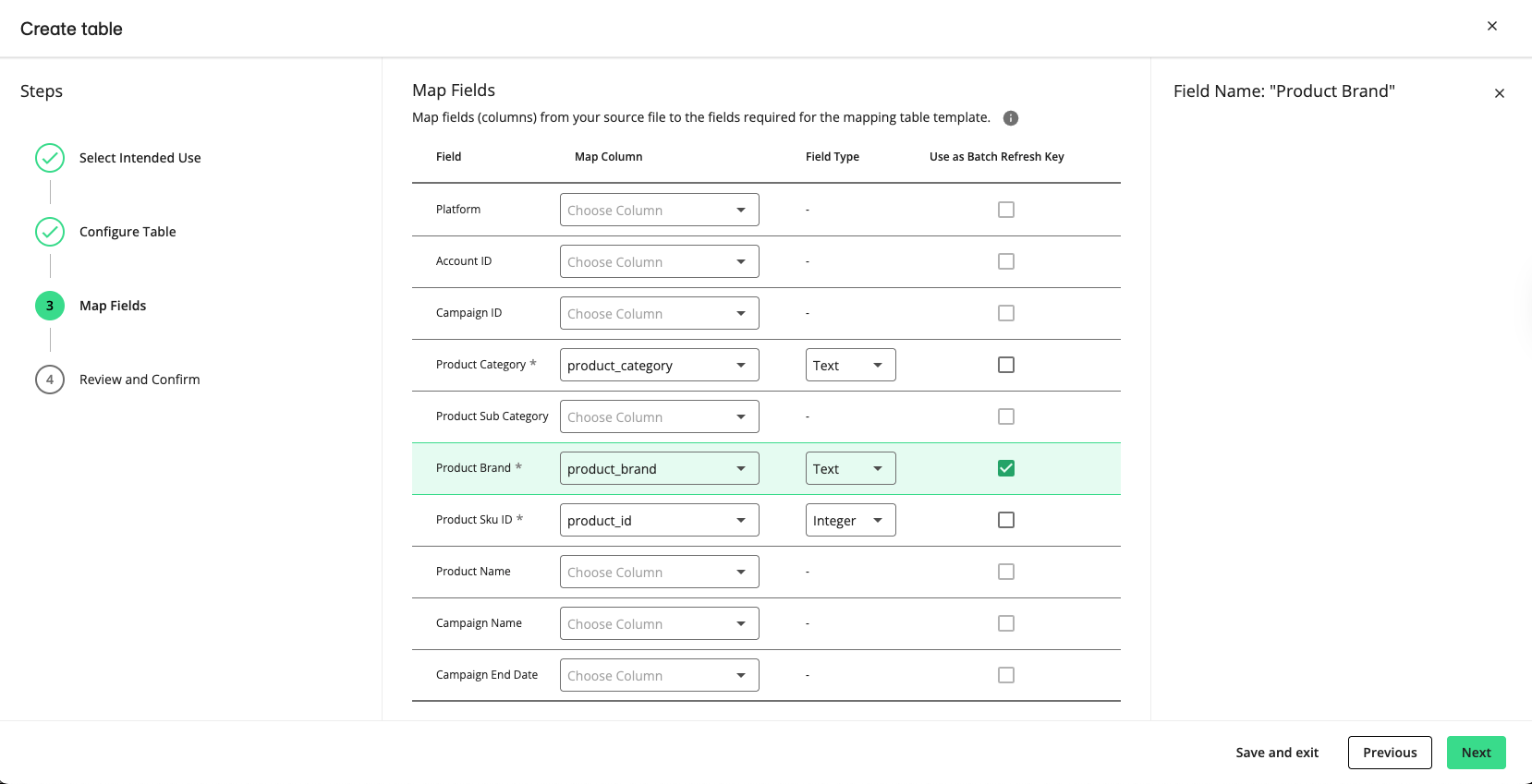
Click .
Review your table configuration, and then click .
The product mapping table you’ve created displays on the Tables and Views page at the top of the list as a Product Taxonomy asset.
Create a Filtered Event Feed View
You can create multiple views, each with different filtering rules applied, to determine how events are routed based on a mapping table's attributes such as SKU, brands, product category, and others.
On the Tables and Views page, click the More Options menu (
) of an event feed table, and select "Create Event Feed View".Select a product mapping/product taxonomy table you want to aggregate against.
Click .
From the Define Rules step, apply the desired filtering based on the attributes (columns) of the selected product mapping table.
Caution
You are required to set a date range for online event feeds.
Only the ‘IS’ operator is supported for the filters. This means you can only create rules where the columns’ values exactly match what you set.
From the “Include all of the following rules” area:
Click .
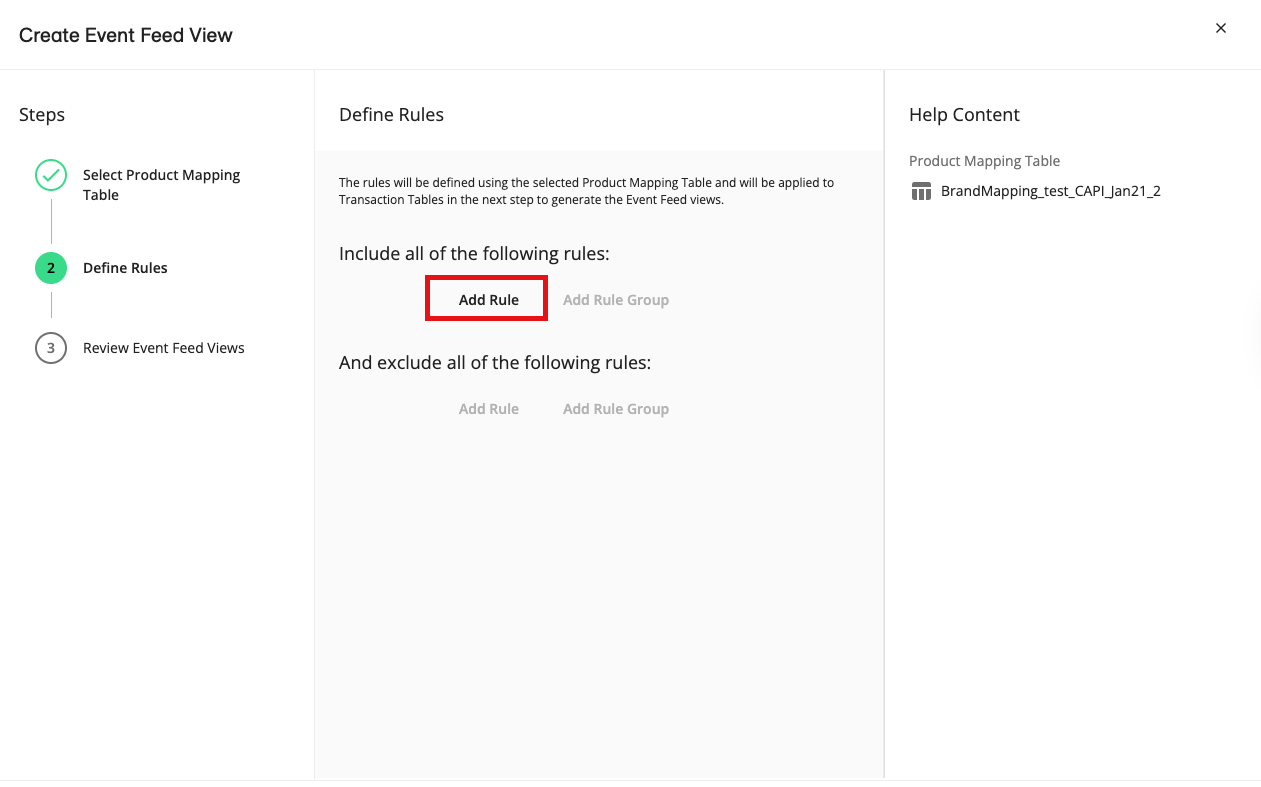
From the column dropdown, select the column you want to set a filter to.
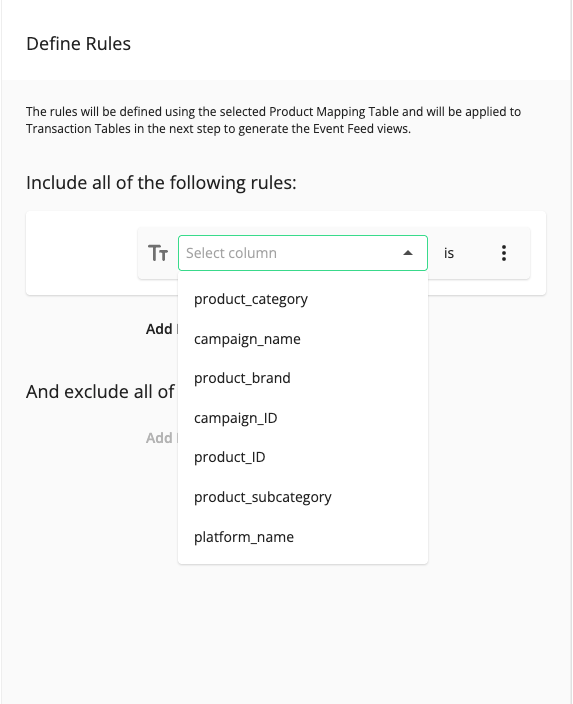
In the value field, enter or select the values to filter on (entered values can contain spaces).
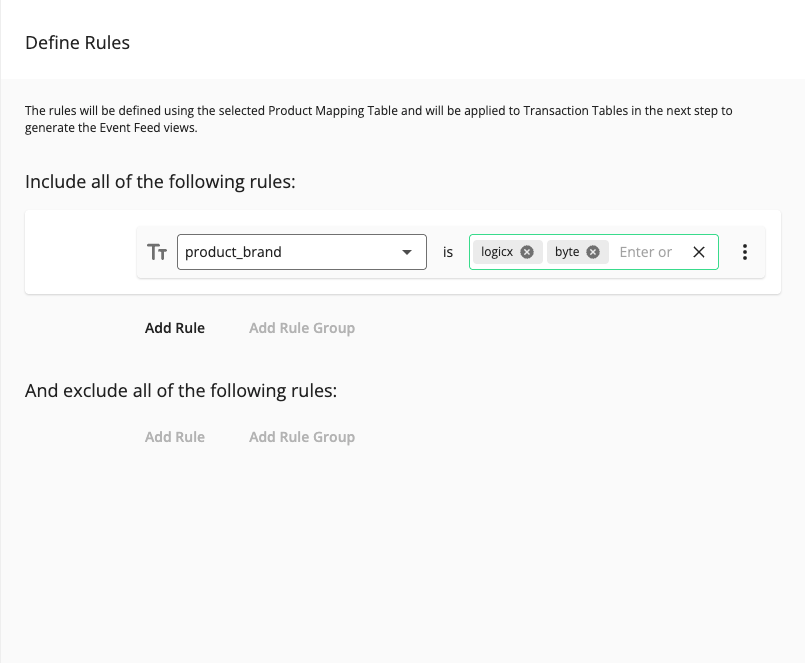
Note
To create views split by brand, you must include a rule against the ‘brand’ column and specify the brands you want to create individual views for.
You will have the option to split the views per brand in the next step.
To add multiple rules joined by the 'And' conjunction, click and repeat the steps above until you have added all the rules you need.
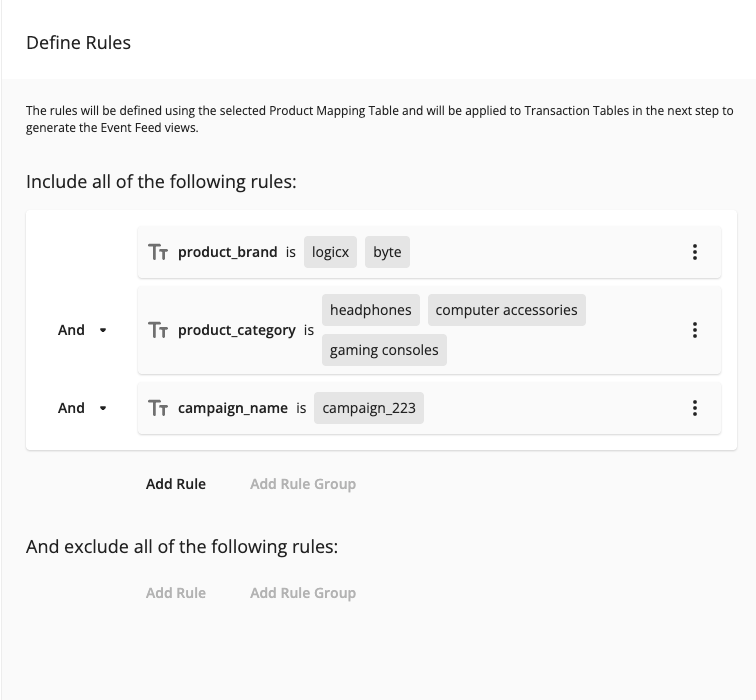
Click .
From the Review Event Feed Views step, you can perform the following actions:
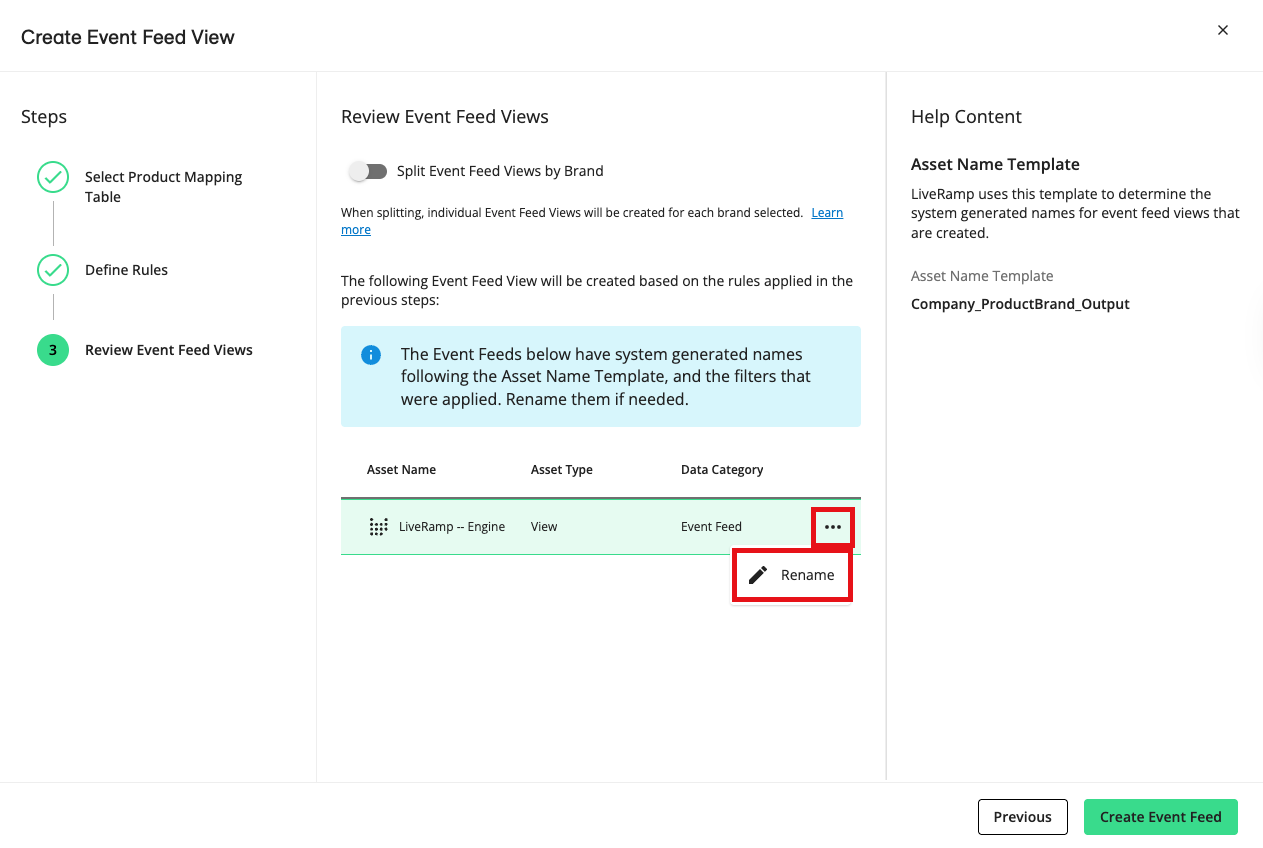
If you have included a rule for the brand column, toggle ‘Split Event Feed Views by Brand’ to create an individual view for each brand. If not enabled, one consolidated view will be generated.
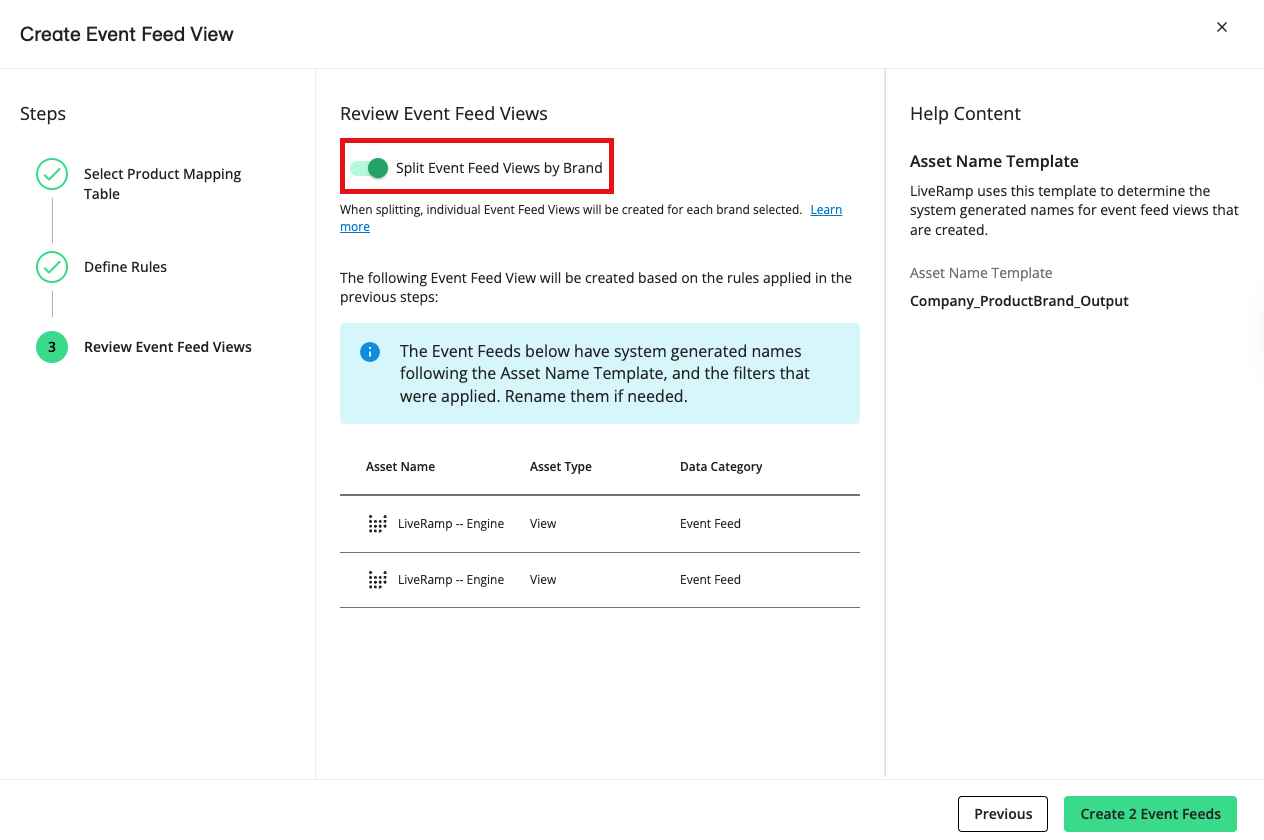
Change the view’s auto-generated name by clicking its More Options menu and selecting ‘Rename’.
Click .
Once the event feed view is created successfully, a pop-up displays that gives you options to create another event feed or distribute the event feed you’ve just created.
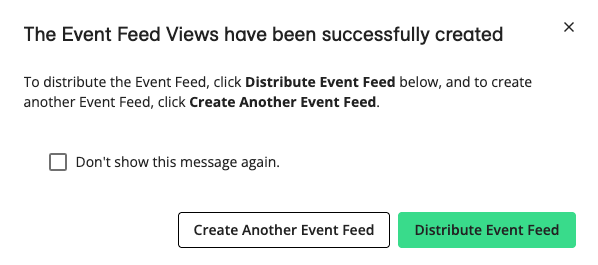
To share and permission the event feed view with other LiveRamp organizations, see "Share Conversion Event Feeds" section below.
To return to the Tables and Views page, click the X button on the pop-up.
Share the Conversion Event Feed with Brand Partners (Brand-Managed Distribution)
Grant your brand partners in LiveRamp access to your filtered conversion event feed views so they can distribute the views on their own, or create child views from them.
Before you begin, contact your LiveRamp representative to allowlist your brand partners so that they are available to select from the Sharing and Permissions wizard.
On the Tables and Views page, click the More Options menu (
) of the view you want to share and select "Sharing and Permissions".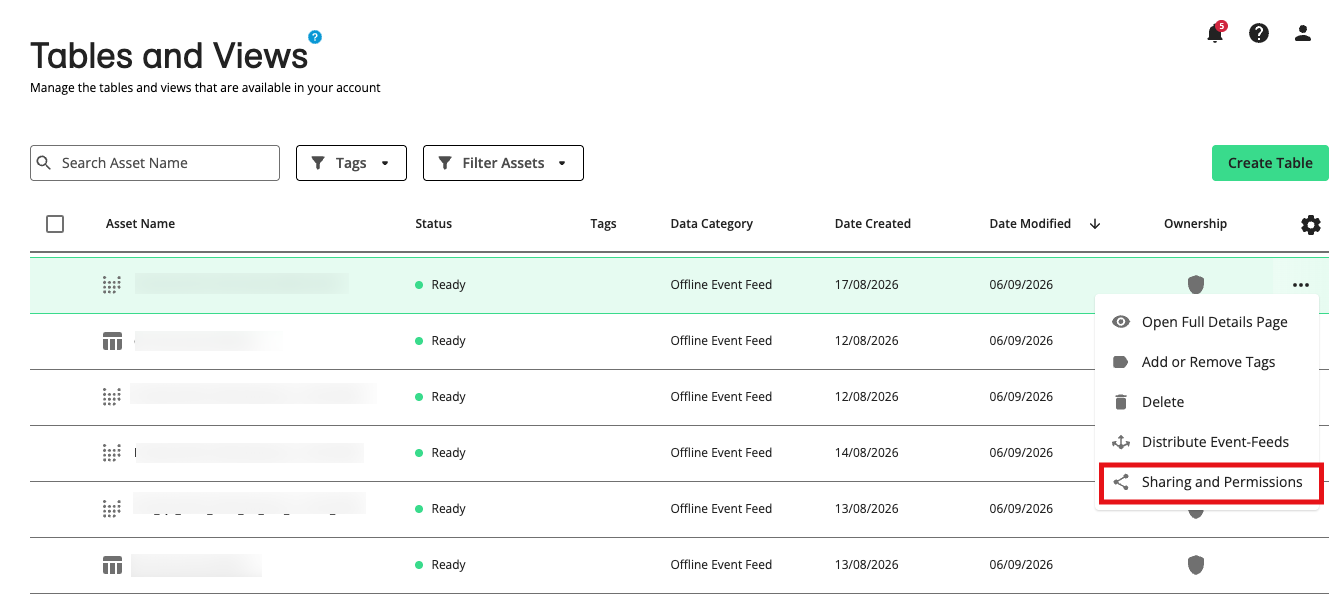
Select the partner organizations you want to share the view with from the allowlisted list.
Using the Set Permissions dropdown, define what your partner is allowed to do with the view.
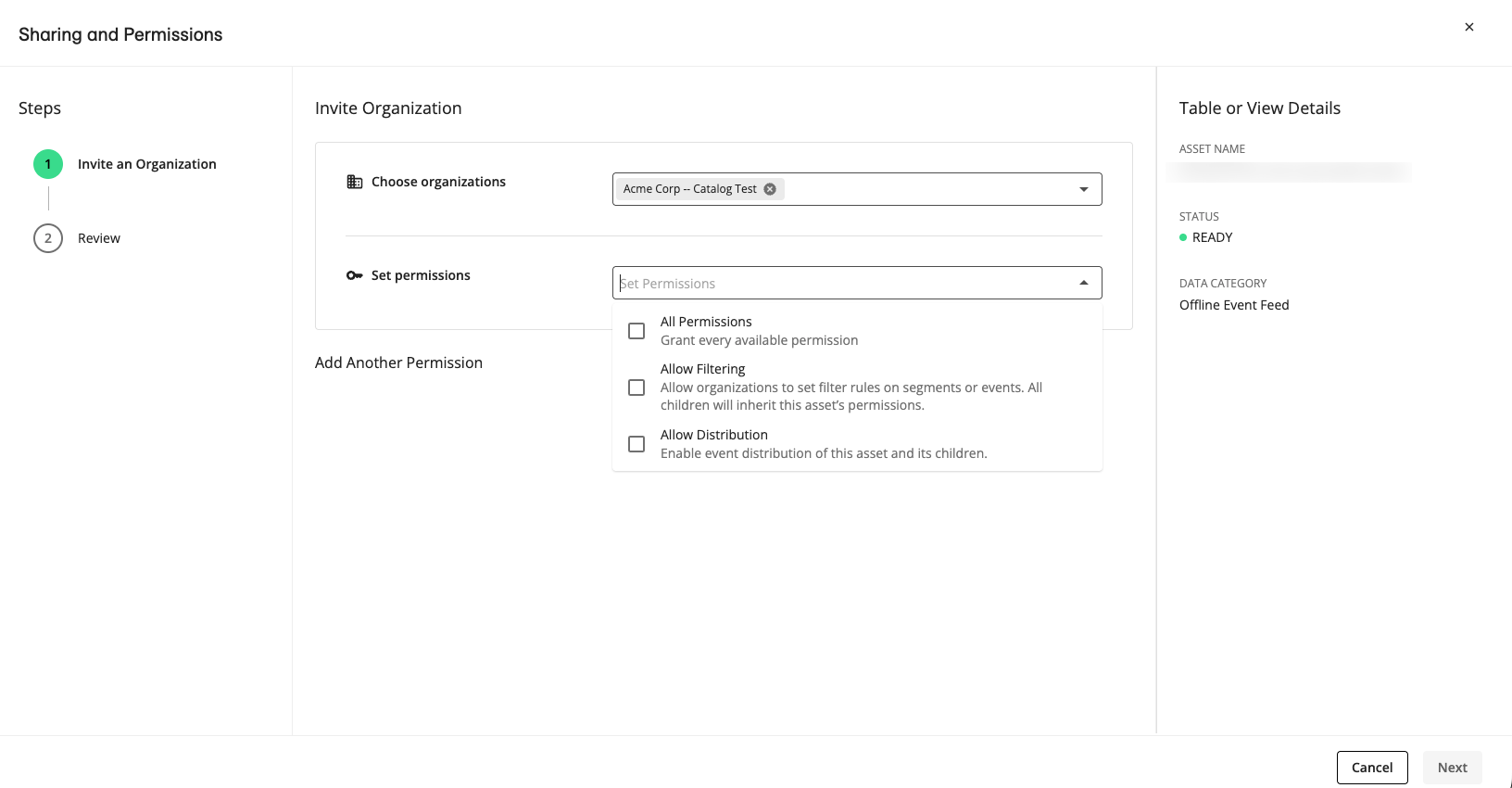
Allow Filtering: Allow organizations to create child views and apply filtering rules to those views.
Allow Distribution: Allow organizations to distribute the view to destination platforms of your choosing. If this option is selected, use the Select Platforms dropdown that displays to select the platforms you want to include in this permission set.
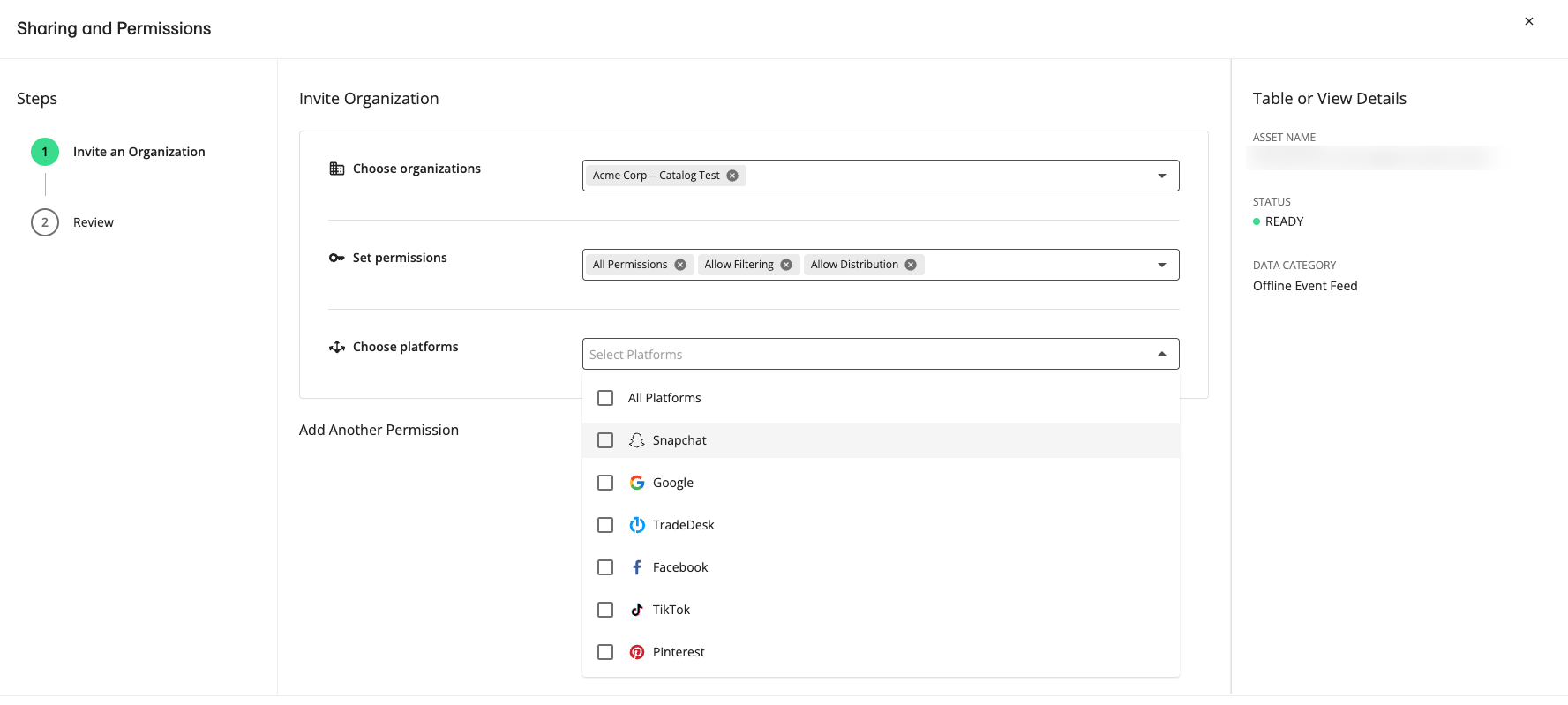
All Permissions: Allow organizations to create filtered child views and distribute those views to selected destination platforms.
To add another permission set, for example, if you want to share the view to other partners, click .
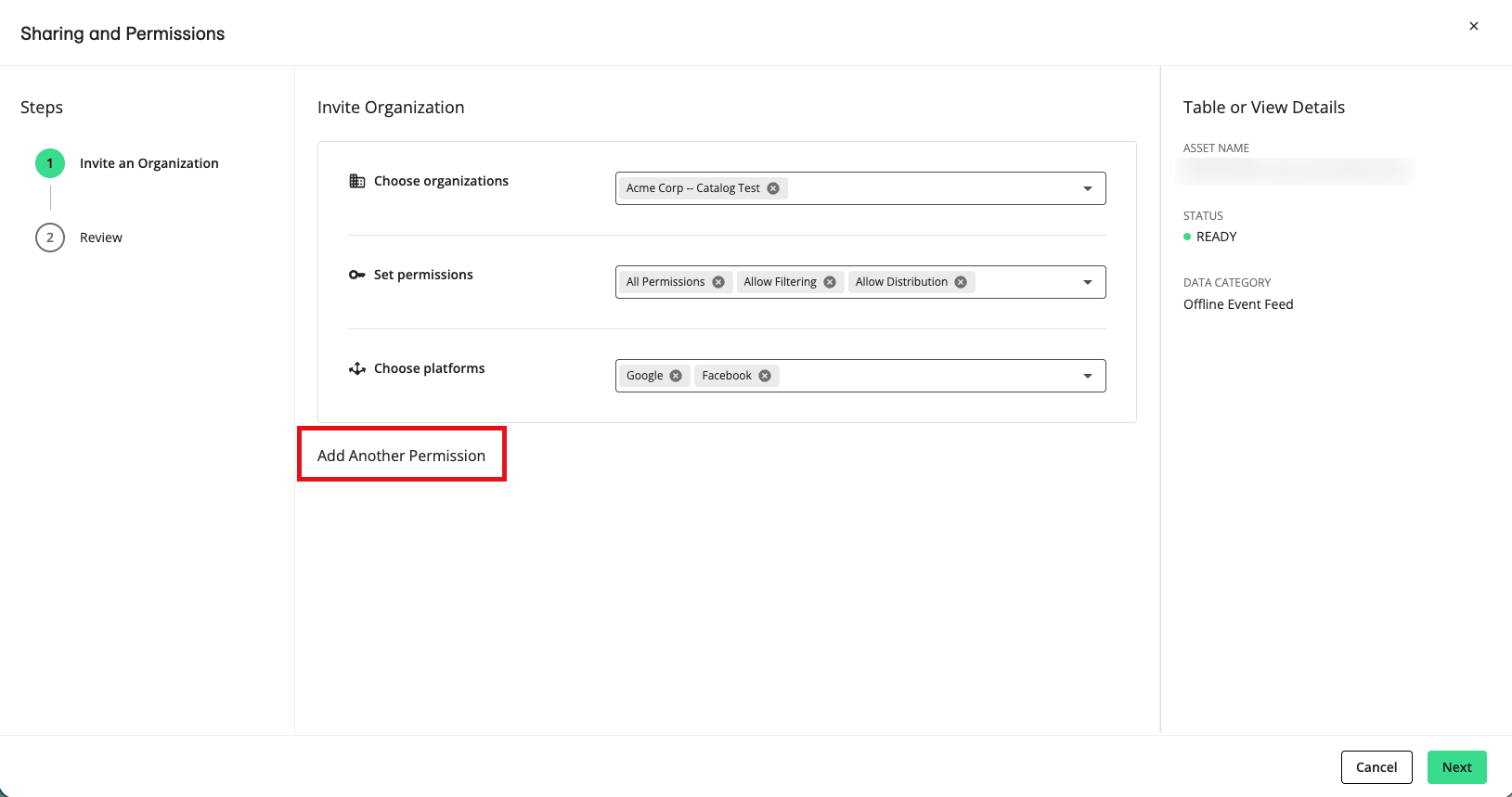
Click .
Review your selection, and click .
Your partner receives an email notifying them that your organization has shared the view. In your partner's account, the event feed view's Ownership column displays Partner Data ( ) with your organization listed as the owner.
For more information on viewing asset details, see "View Details for Tables and Views".
Enable Online Conversions API Connectors in Console
To connect online conversion data, contact a LiveRamp representative to set up the Online CAPI connectors in Console and link them to your Connect account.
Once configured, LiveRamp will generate an 'Online Event Feed' table on the Tables and Views page. If you have a product mapping table, you can create a filtered online event feed so that only relevant events are delivered to your preferred platforms.
To learn more about the Online Conversions API connectors, see "Online Conversions API Connectors".