View Details for Tables and Views
You can view asset details in the details panel or full details page of the Table and Views page. The details panel view is useful if you want to quickly view details from one asset to the next in the Tables and Views table. The detail page is useful to view more details of the asset.
Tip
To view an interactive walkthrough demo of viewing details for tables and views, click here.
There are two ways you can view segment details on the Segments page:
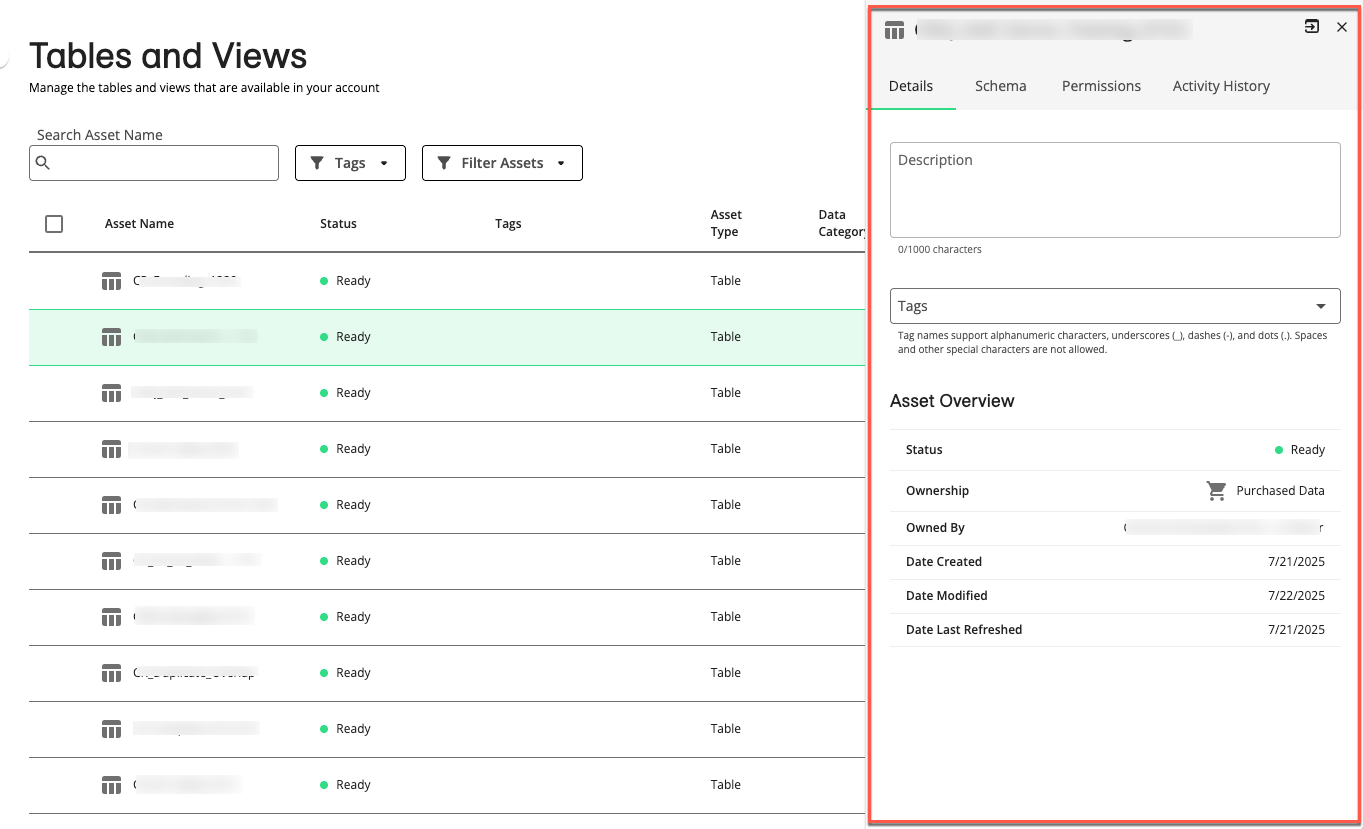
Details Panel: Click on the row of an asset to display the details panel and view asset details, schema, permissions, and activity history.
Full Details Page: Double-click on the row of an asset to display (depending on the kind of asset it is) the details, schema, permissions, and activity history tabs,
Tip
Select the More Options menu (
 ) of an asset row and click .
Select the check box to the left of an asset row and click at the bottom-right of the Tables and Views page.
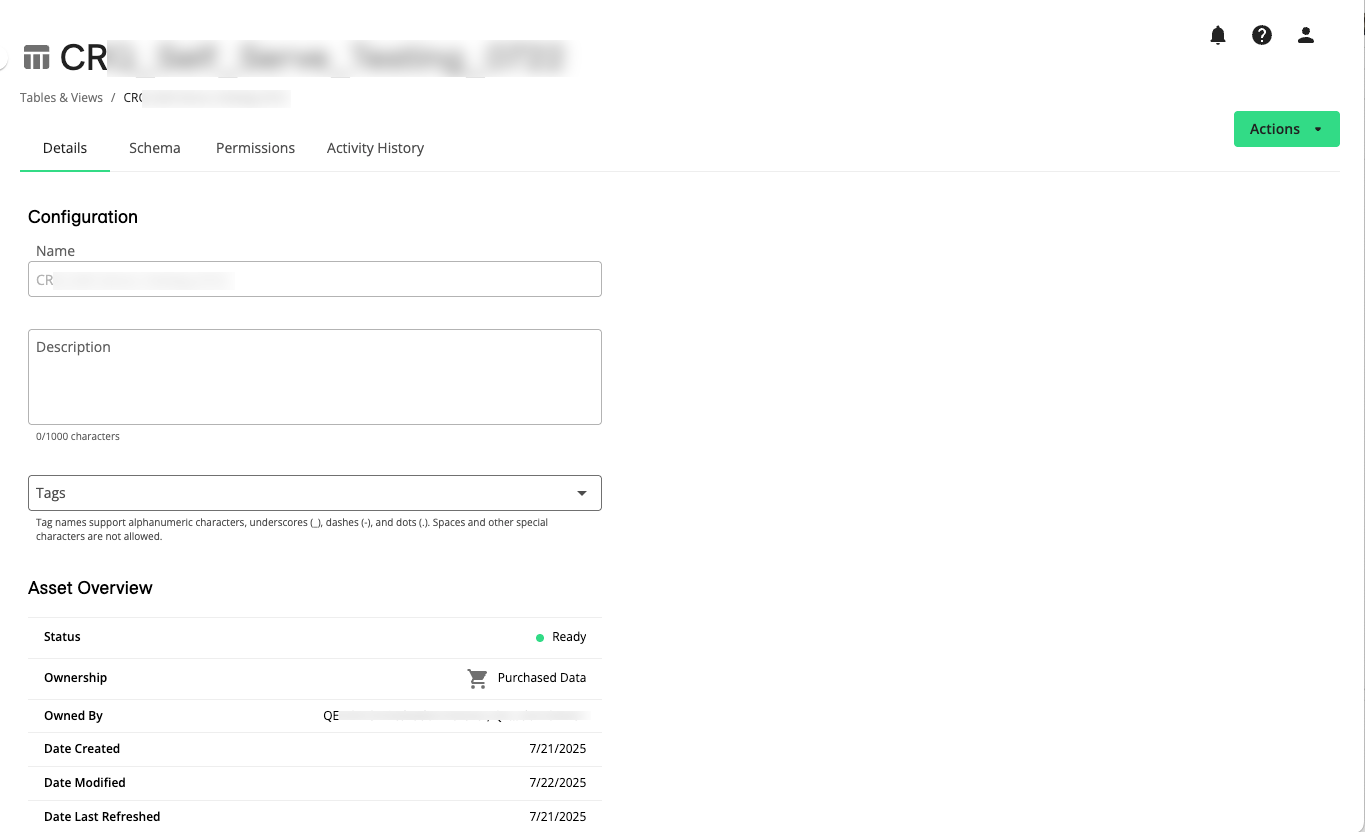
The following tabs display asset details on the details panel and full details page.
Details
The Details tab displays the following information about the asset:
Configuration
Description: The description of the asset.
Tags: A dropdown list of available asset tags. Use the check boxes to add or remove tags on the asset. To add a new tag, enter the name and click . Tag names support alphanumeric characters, underscores (_), dashes (-), and dots (.). Spaces and other special characters are not allowed.
Asset Overview
Status: The status of the asset. See “Asset Statuses”.
Ownership: The ownership of the asset:
 My Data (first-party data): Data you've brought into LiveRamp (including data you've collected yourself and data you've purchased outside of LiveRamp)
 Partner Data (second-party data): Data that's been permissioned to you by a LiveRamp partner or that originated in Clean Room
 Purchased Data (third-party data): Data that you've purchased in the LiveRamp Data Marketplace
Owned By: The name of the organization that owns the asset.
Date Modified: The date when the asset was updated.
Date Last Refreshed: The date the asset was last refreshed.
Schema
The Schema tab displays the table or view’s schema, including the column (field) name and field type of each field. You can search for column names in the schema.
Note
RampIDs, household IDs, and sensitive columns will never be displayed in the schema.
Filter Rules
The Filter Rules tab displays rules that have been defined to create an event feed view asset. Rules are created using attributes from a product mapping table and applied to the underlying table that backs the view.
Permissions
The Permissions tab displays permission details for assets that contain partner data or assets which have been shared to other other organizations.
If your asset originates from a clean room, the following information displays:
Permission Details
Partner: The partner who owns the asset.
Clean Room: The name of the clean room the asset came from.
Clean Room End Date: The end date of the permission to use the asset.
Collaboration Rules
Combine: The allowed data combinations in this clean room.
Activate: Whether you can activate this data and to which destinations.
Additional Activation Fee: Whether additional activation fees apply when activating this data.
For event feed views, the Asset Permissions table displays the following columns:
Organization: The organization that owns the data. If the asset belongs to your organization, this column displays the organizations that the data has been shared with.
Permission types: The actions allowed to be performed on the data, which can be one or all of the following:
Allow distribution: Allow organizations to distribute the events to destination platforms of your choosing.
Allow filtering: Allow organizations to create child views and apply filtering rules to those views.
Destinations: The allowed destination platforms, if distribution is allowed.
Files
The Files tab displays the files that feed into the table asset. This information is only available on the full details page. The following information is available for each file:
Config ID: The ingestion ID of the file, used for troubleshooting purposes.
File Name: The name of the file.
Processing Status: The processing status of the file, which can be one of the following:
Completed
Processing
Skipped
Delivering
Failed
Date/Time Processed: The date and time when the file finished processing.
Input Rows: The total number of rows in the input file.
Output Rows: The number of rows in the final output file.
Invalid Rows: The number of rows that contain an invalid identifier.
Total RampIDs: The total number of RampIDs that the rows in the file matched to.
Recognition Rate: The percentage of rows that were matched to a RampID.
Activity History
The Activity History tab displays historical logs of actions taken on the asset, and lists activity date and time, the type of activity, and any details of the activity. If a child asset has been created or updated, click the hyperlink to go to the Details page of the child asset.
Select the Hide Data Refreshes toggle to hide (default) or display data refresh events in the Activity History table. You can use the Filter drop-down to view and filter the following information:
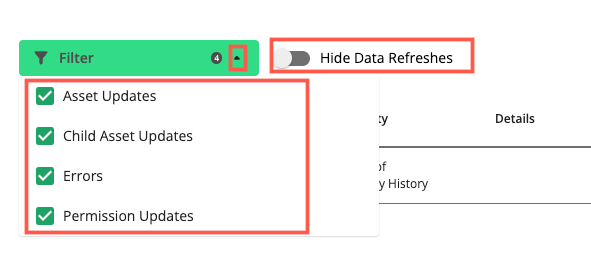
Asset Updates: e.g., asset creation
Child Asset Updates: e.g., child asset creation
Errors: e.g., asset marked invalid because underlying data was deleted
Permission Updates: e.g., permission changes